Information continues to trickle out about the Hunan story, and I wanted to provide a brief update because this information is of vital importance to all families that have adopted children from China.
I must first come to the defense of NPR reporter Anthony Kuhn. Many adoptive families have disparaged him for the minor inaccuracy in his report regarding the adoption fee paid to the orphanages ($30,000 instead of $3,000). Because of this inaccuracy, many sought for "more reliable" information.
Anthony was the only reporter posting reports from the trial. When his identity became known (the trial was closed to reporters) he was held for over 5 hours in police custody and questioned. He filed the report broadcast on NPR in the early hours of the morning so that it could be heard by us on "All Things Considered". He did an outstanding job, and we owe him and NPR a huge debt of gratitude.
Proved in the trial, but ignored (intentionally) by the official Government press release are the following facts:
The first person in the chain of transport from Wuchuan (actually, from Anthony's description of her town I believe it to be Huangpo Town, an area that falls under the jurisdiction of both the Wuchuan and Zhanjiang orphanages. Having researched in this area, I can attest to its being an area where many children are found) was Liang Gui Hong, a 56 year-old woman. Families with unwanted children approached this woman, due to her well-known connections for finding homes for unwanted children (she apparently has been facilitating adoptions for over 10 years). These parents would give Ms. Liang a "Lucky Money" envelope with 20 or 30 yuan in it as thanks for locating a family to care for their children. No money was paid to the birth parents for their children, and no birth parents were ever approached about giving up their child. Ms. Liang initially took in some of these girls herself, caring for them until she could locate adoptive families.
A connection was made when Ms. Liang met one of the children of a Mr. Duan of Changning City, Hunan. This person worked in Wuchuan, and another of Duan's children worked at the Qidong orphanage in Hunan. Ms. Liang was convinced that the Qidong orphanage worker could provide connections so that all of these children could be adopted through the orphanages.
It is unclear how much each of the participants were paid, but a total of 400 yuan seems to have been paid by the orphanages for each child ($50). It is, however, clear that the orphanages obtained these children to adopt internationally, as that is where the largest benefit is derived (see my earlier blog "The Finances of Baby Trafficing" for more background on why this is so). I doubt that this was done with any degree of malice, but rather viewed as a win-win by all involved.
Let me again re-emphasize that these children were not kidnapped, abducted, or purchased from birth parents. They were given to Ms.Liang because she had perceived connections, and because she eliminated the risk to the birth family of abandoning their child themselves. In all likelihood, as one adoptive parent writes (and was repeatedly stated in the trial), all concerned viewed this program as a benefit to the children involved.

Monday, February 27, 2006


Thursday, February 23, 2006
What is the Truth in Hunan?
The trial began this week for 10 individuals, including one orphanage director, involved in last November's Hunan baby scandal. As reported last year, 50 individuals were arrested after allegations were made by an orphanage employee that the infants being trafficked had been kidnapped. As speculation began to mount that perhaps some of these children had been adopted internationally, the Chinese government stopped the press in China from reporting on the story, leaving thousands of adoptive families wondering what had really happened.
But as Anthony Kuhn reports on NPR's "All Things Considered", as the trial gets underway this week in Hunan, the defense is proving that things were not all that they appeared. Forty of the original fifty defendants have been released. After two days of defense witnesses in the trial of the remaining ten, it appears that the children involved were not kidnapped, but purchased from birth parents and trafficked to Hunan for adoption.
All eighteen children were girls, each having birth dates within a few days of each other. All eighteen were from a town near Wuchuan in Guangdong Province. No police reports were received for any of the missing children, and no parents came forward after the publishing of the pictures of the children in an area newspaper.
So, the kidnapping charges will be dropped, right? It is not that simple. Apparently this story is exposing a darker side of Chinese bureacracy, and officials are afraid that the defense testimony will reveal the graft and corruption imbedded in the local government of Hengyang. The defense is showing that the trafficking and adoption of babies is a pie many people have their fingers in, and to avoid an international scandal, pressure is being put on the judge of this case to convict the director and his nine co-defendants regardless of the evidence.
But for adoptive families, it is of great comfort to know that the children involved in this case (at least the 18 involved in the current trial) were not kidnapped, but were brokered by their birth parents to a conduit woman who brought them to the orphanage for sale. No doubt this knowledge will allow all of us greater peace of mind as we tuck our Chinese daughters and sons into bed tonight.
(To listen to NPR's report, click here)
But as Anthony Kuhn reports on NPR's "All Things Considered", as the trial gets underway this week in Hunan, the defense is proving that things were not all that they appeared. Forty of the original fifty defendants have been released. After two days of defense witnesses in the trial of the remaining ten, it appears that the children involved were not kidnapped, but purchased from birth parents and trafficked to Hunan for adoption.
All eighteen children were girls, each having birth dates within a few days of each other. All eighteen were from a town near Wuchuan in Guangdong Province. No police reports were received for any of the missing children, and no parents came forward after the publishing of the pictures of the children in an area newspaper.
So, the kidnapping charges will be dropped, right? It is not that simple. Apparently this story is exposing a darker side of Chinese bureacracy, and officials are afraid that the defense testimony will reveal the graft and corruption imbedded in the local government of Hengyang. The defense is showing that the trafficking and adoption of babies is a pie many people have their fingers in, and to avoid an international scandal, pressure is being put on the judge of this case to convict the director and his nine co-defendants regardless of the evidence.
But for adoptive families, it is of great comfort to know that the children involved in this case (at least the 18 involved in the current trial) were not kidnapped, but were brokered by their birth parents to a conduit woman who brought them to the orphanage for sale. No doubt this knowledge will allow all of us greater peace of mind as we tuck our Chinese daughters and sons into bed tonight.
(To listen to NPR's report, click here)
Thursday, February 16, 2006
The Value of Life in China
 As we returned from researching in a small village north of Changde, we came upon a small puppy lying in the street, it having just been hit by a car. Obviously suffering from fatal wounds, it nevertheless struggled with its front paws to crawl out of the way of traffic. I commanded the taxi driver to pull over, and jumped out and rushed back to the dying animal. I picked it up by the scruff of its neck, and gingerly carried it to the side of the road.
As I knelt down beside the whimpering puppy, my mind was filled with a similar experience I had a decade ago when I lived in the foothills of Utah Valley. One evening as we drove home from work, a young doe and her yearling fawn darted in front of my car as we navigated the icy road home. Unable to avoid hitting the fawn, I immediately jumped out to ascertain if it had been killed by the impact. I found it struggling on the side of the road, all four legs suffering from severe compound fractures.
My mind began to panic as I struggled to determine what was the best course of action. I had no weapon with which to dispatch the poor animal. Its obvious suffering prevented me from going home and returning, since that would have taken at least 15 minutes. Finally I decided that the best thing to do was to place my hands around its throat and calmly reassure it as it died from strangulation. It was the worst experience of my life.
Today I found myself again kneeling at the side of the road, again called upon to assist another animal in passing. As I calmly coaxed the puppy to die, I became aware of the crowd of people surrounding me. What was truly depressing to me was that they were not watching what I was doing, so much as marveling that I was doing it. The looks in their faces showed me that they simply didn't understand why I was helping this poor wounded animal die. Some giggled, some stood with hands over their mouths; all watched in rapt attention as this strange American knelt beside this puppy, gently stroking its ears and head as his other hand throttled its throat.
Life is cheap in China. This point has been borne to me again and again in my experiences doing research, especially in the countryside. There is little respect for the suffering of animals here. The general consensus seems to be that animal life is truly worthless. One need only to walk through the meat markets of any of China's many towns and villages to see how brutally that conception is carried out.
The Chinese witness the endless cycle of life and death daily. Although her largest cities now contain the supermarkets that we in the west find ubiquitous, most in China still eat food purchased "on the hoof" in the local markets. This daily barrage of death has a desensitizing effect on its witnesses. It diminishes the value of all life.
I remember reading the story a few years ago of a baby girl that was found dead in a city street in Hunan (Marie Claire, Spring 2001). At the time I thought the story just another case of China-bashing, that there was simply no way it could have happened. But as I have become more familiar with the attitudes of China regarding death and dying, I realize that the Marie Claire story was not only possible, but likely.
When we ponder the realities of the families involved in the abandonment issue in China, we must realize that the motives, emotions, and experiences that we imagine each birth family to have experienced is formulated by our own experiences in the West. These experiences, however, are not the Chinese experience. There is a large cultural divide separating us from the average Chinese, particularly those that watch the endless cycle of birth and death in China's countrysides.
After what seemed like an eternity, the strong puppy died. As I knelt there with this dead animal in my hands, I contemplated what I should do with it. To leave it there seemed strangely inappropriate. I searched around and found a small nylon bag, in which I placed the limp body. As I stood and turned to face the crowd gathered around me, I felt oddly out of place, like I had just performed an act wildly out of context. I carried the bag to a small trash pile by a tree, placed it gently on the ground, got back in my taxi and drove off, followed in my every move by a sea of faces who will never understand what occurred in front of their eyes.
Monday, January 30, 2006
A Response to Parade Magazine
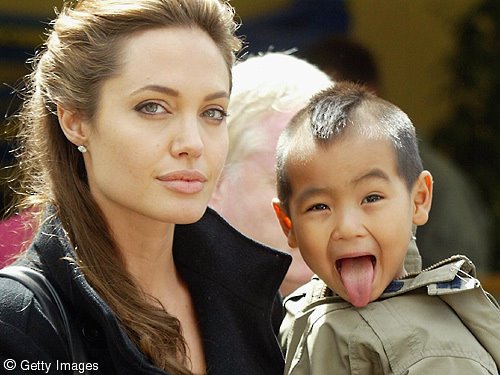 It is a familiar refrain: “Why did you adopt from China, when so many children need homes here in the U.S.?” A recent question in “Parade Magazine” posed the same question this way (Sunday, January 29, 2005):
Q: Why do stars like Brad Pitt and Angelina Jolie adopt foreign kids when many are waiting here?
Parade’s answer was: In Hollywood, it's fashionable to adopt infants from the Third World. "Also, many believe there's less red tape outside the U.S. Often it's worse," explains actor Henry Winkler. He works with the Children's Action Network, which says 119,000 foster-care kids in the US are eligible for adoption.
How many children are truly available for adoption in the U.S.? An analysis of the U.S. government’s most recent statistics shows the following (2003):
In 2003 (the most recent year for which information is available) there were 25,070 children under the age of one year in the foster care program. There was an additional 129,000 children between one year and five years in the program. There are of course many more children older than 5 in the foster care program, but we will limit our discussion to this population of kids, because it is the age group most attractive for adopting parents.
An important point to keep in mind, however, is that not all of the children in the foster care program are eligible for adoption. The U.S. foster care program serves many purposes, primary of which is child protection. Most of the children (55%) in the program will end up being reunited with their birth parents, an outcome that is preferred. An additional 11% end up living with relatives. In 2003, only 18% ended up being adopted by an unrelated family.
Because reunification is a primary goal of the foster care program, States have established set evaluation timeframes for birth parents to regain custody of their children. This period prevents young children from being adopted quickly, and therefore very few children under the age of 1 year are available for adoption. Although Mr. Winkler correctly quotes a figure of 119,000 children being available for adoption, it is instructive to see how that number breaks down.
Of the 119,000 children available for adoption in 2003, only 3,850 children were under a year old (3%). An additional 38,200 (32%) children between the age of one year and five years were available for adoption, but almost certainly the majority of children were four- or five-year olds. The majority of the children available for adoption were between six and fifteen years of age (58%).
Thus, if a family desires to adopt a young infant or toddler, there are few opportunities available in the U.S. foster care program. In fact, the vast majority of adoptable children are in excess of five years old, with the median age being over ten years old.
These children need homes, of that there is no doubt. In a perfect world every child, regardless of his or her age, would be adopted into a loving family. But in the real world, the vast majority of couples looking to build a family seek for a variety of reasons to adopt a child that is as young as possible. The U.S. foster care program is ill equipped to provide the numbers of babies desired by adopting families. Thus, most are forced to look overseas, or to arrange for private adoptions (which bring in many ethical problems also).
In addition, there are serious concerns on the part of adoptive parents when it comes to adopting a child from the foster care program. Several well-publicized cases in which birth parents sued and regained custody of legally adopted children has nurtured a fear that no adoptive family wants realized. Also, many adoptive families are reluctant to take on the emotional scarring that many in the foster care program have experienced. Another factor is the bureaucracy involved with adopting a child from the foster care program, which, contrary to Mr. Winkler’s assessment, is almost always more burdensome than adopting internationally.
I guess the point that bothers me most about the question asked by the reader of Parade Magazine is that it is almost always posed by those who have not adopted at all. Instead of impugning the characters of the Meg Ryans and Angelina Jolies of the world, why don’t these same people simply adopt a child from the foster care program? Calling their adoption "fashionable" demeans the great thing they, or anyone adopting a child, has done. I guess I would respond to those that ask this question, “Unless you have adopted an orphaned child from anywhere in the world, either here in the U.S. or overseas, keep your cynical questions and comments to yourself!”
Are Angelina Jolie and Meg Ryan part of a new trend in Hollywood? I certainly hope so! I applaud both women for bringing attention to the orphans of the world, wherever they are. Both women are helping to increase the acceptability of adoption, and should be praised for the attention they are bringing to this subject. The reality is that our culture holds up natural childbirth as the preferred method for gaining a family, and adoption is almost universally viewed as a second choice. Public figures like Angelina Jolie are working to change that culture, and bring the status of adoption to higher esteem. Only then will there be hope for the millions of orphaned children in the world.
Subscribe to:
Posts (Atom)
