Friday, September 09, 2005

The Other Mother


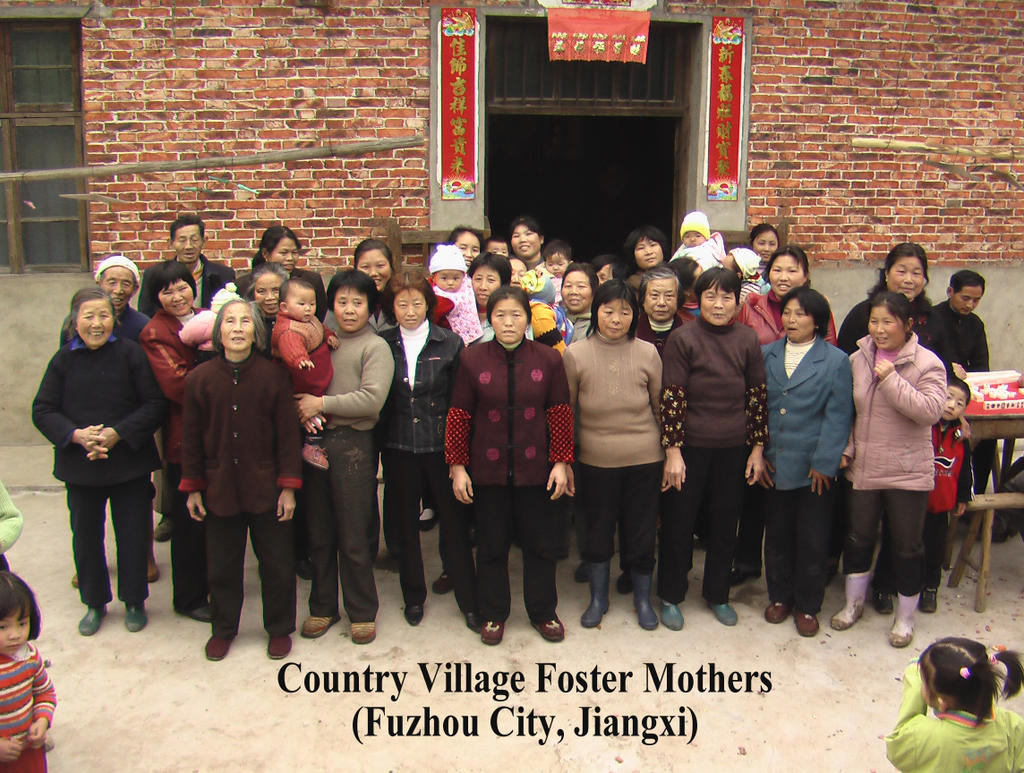
The women had begun to gather before we had even arrived. As we traveled to this remote village in Fuzhou, Jiangxi Province, I had hoped to find the foster family for the girl I was doing research for. The foster mother had slipped her phone number between the girl’s clothes on the day she was delivered to the adoptive family, and we had called her to get directions to her home. Now, as we approached her house, I could see scores of other women running across the fields towards us.

As adoptive parents, most of us think at one time or another on our children’s biological parents. But often lost in the adoption process is an awareness that our children sometimes have three mothers, not just two.

Many orphanages in China utilize foster programs to care for the children prior to adoption – either due to space constraints in the orphanage, or because the administration believes that a home environment is healthier for the emotional well-being of the child.
Although most foster families apply to foster children to supplement their income, it is obvious to me that most deeply love the children they care for. Foster families earn between 400 and 500 yuan ($50 to $60) a month caring for each child. Orphanages fund their foster programs with assistance from the government (150 yuan per child) combined with money derived from adoption donations. Because fostering costs more money than caring for the child in the orphanage, some facilities try to limit the number of children placed in foster care, sometimes placing only the healthy children in foster care, or only the special needs children. A few, like the Yongfeng orphanage in Jiangxi, place almost all of their children in foster families, keeping only a small number of children in the orphanage facility to satisfy minimums established by the local Civil Affairs Office. Still others, like the Fengcheng orphanage in Jiangxi Province, are in the process of upgrading their facilities so that all of the children in their care can be cared for “in house”.

Most foster families are older married couples, with a husband working in a low-paying manual job and grown or almost grown children. Many live in the rural areas around the cities, but few live on farms. The average foster family home is a two-bedroom single-story house with a very small kitchen, two small bedrooms, and a larger living room that opens to the outside. A majority of foster families have the children in their care sleep with them in their bedrooms, either in simple cribs or in a family-bed arrangement.

Nearly all of the foster families that I have met long for the children that they cared for. Some express wishes that they could have afforded to adopt the children themselves. A small percentage foster only one or two children, the separation process being so emotionally painful that they refuse to care for more children. One foster family in Yulin, Shaanxi Province spoke of the two children they had watched as if they were their own, and kept their pictures on the wall of their living room. My own experience with my youngest daughter’s foster parents has served to convince me how deeply my daughter was loved by them. While completing the adoption process, we asked (as most adoptive families do) to meet the foster family that had cared for our daughter for almost three years. Due to repeated prohibitions from the CCAA, most orphanages are extremely reticent to allow this kind of contact, but we prevailed upon the orphanage director, and he arranged for the foster family to drive down to our hotel to say good-bye to our daughter, and to meet her new parents. As we all talked with each other, no one noticed the foster mother take our daughter’s hand and walk out of the hotel lobby, disappearing into the traffic and crowds. An anxious 19 hours later the mother was located with our daughter. This woman simply could not bear to let her “daughter” go.

It is clear from my interviews with weeping foster mothers that many go through a painful emotional heartbreak when they are told to bring the children back to the orphanage for adoption.
As adoptive families, we long to get in contact with our children’s foster families. Even today, I still desire to remain in contact, albeit very controlled contact, with my daughter’s foster mother. She has, like most other foster mothers, valuable photos, anecdotes, and medical histories that are otherwise unavailable to us. I have tried unsuccessfully for three years to find the foster family for my daughter Meigon, whom I adopted at 19 months. I fantasize about discovering her foster family and retrieving infant photos, humorous anecdotes, and information on the various scars Meigon carries on her body (small, but interesting nevertheless). But each time I have approached the orphanage I have been denied access. (Since writing this essay I did locate Meigon's foster mother. That story can be read at http://research-china.blogspot.com/2005/10/ripples.html

As we approached the village of the foster family of my research child, we were swarmed by over thirty foster mothers, all gripping pictures of their “children”, begging me for information on how they were doing. Some wept as they described the children they had cared for. All wanted to be reassured that their foster daughters were happy and well cared for. As we concluded our interviews, retrieved our lists, and headed back, my thoughts continued to dwell on these women who cared for, and loved, our children, preparing them for the families that would soon come to take them home.

Saturday, September 03, 2005

My Girl and Her Cub

The following experience occurred following a research trip in February 2005.
__________________

The young Bengal tiger fought to keep the bottle in his mouth. I remained frozen, watching unbelievably as my seven year-old Meikina held the bottle over its head, carefully cradling it as the beautiful cat ate hungrily from the bottle in her hand.

Few things demonstrate the vast cultural differences between China and the U.S. more ably than a visit to Guangzhou's Panyu Wildlife Safari Zoo. My first visit to this place was in 2002 when I came here with my newly adopted daughter Meigon and Meikina. On that trip we were able to pet a bear cub, shake hands with a seal, and give bananas to the elephants.

I am not a fan of zoos. I struggle to balance the incredible sadness I see in the faces of the animals, especially the primates, with the lessons in appreciation I hope will be gained by my children. I believe that sometimes the balance isn't found, as in the case of Guangzhou's City Zoo, where small cages result in endless pacing by the big cats and other inhabitants. Even the Chinese don't like going there.

But the Panyu zoo is a different story. Most of the exhibits are large, open-air in design. The animals seem well fed and maintained. But it is the proximity that the zoo allows that I feel most impressive.

Next to the tiger cub exhibit was a gorgeous mature white tiger, lying magnificently on a wooden platform. For 30 yuan ($3.75) you could sit down next to him and have your picture taken. Where in the U.S. can one go and sit next to such a fine specimen of nature? Further down was an arena where lion cubs played with some dogs and goats (a motley group, I must admit). As my daughters peered over the railing, a curious lion cub walked over and lifted her head, bringing herself within a foot of the faces of my daughters. They could smell her breath.

A favorite tradition of ours is to watch the Elephant show, and then have our picture taken on top of one of the stars. All of my girls took turns climbing up, and I stood next to the Elephant, gently scratching its ear, while it wrapped its trunk around my arm and gave it a squeeze. It felt like I was next to an old friend.

I have often felt a connection as I have gotten close to animals. I see it in the eyes of my pet dogs, and I have seen it in the eyes of other animals I have gotten close to. The one thing all of these experiences had was that I was able to get close, much closer than is ever allowed in the zoos and animal parks in the U.S. I believe it is this proximity of man to animal that teaches our
children to respect the life others, to appreciate the many different and wonderful creatures we find on this beautiful earth.

But our culture has become a culture of fear. Businesses (including zoos) see each visitor as a potential multi-million dollar lawsuit. Thus, to protect themselves (and the animals) they isolate and prevent any contact between the inhabitants and the visitors. It's too bad, because I yearn to give my children the appreciation for life that close contact with animals brings.

I'm sure the days of such opportunities are limited even in China. But while they remain, you can bet I will be here as often as possible, letting my girls feed the elephants, stroke the seals, and give the milk bottle to a tiger cub.

Saturday, August 27, 2005

The Value of a Grain of Rice

The following essay was written while I researched in beautiful Guilin (Guangxi) in August 2005.

The countryside was a blur from my taxi window as we headed back toward Guilin. In front of me, in a broken mosaic of olive and green patches, were the acre-sized farm fields. Some held grape vines, hanging heavy with the year’s production. Most, however, contained the nearly white heads of rice, on this August day ready for harvest.

Suddenly my eye was drawn to a group of four people laboring at a small mechanical rice thresher. I bid our driver to stop, and exited my cool taxi into the blazing heat of a Chinese summer day. I strolled into the field, and settled down to watch, beads of perspiration already falling from my forehead.

All around me the rice had been hand cut and gathered into bunches, tied with a single strand of rice stalk. As I watched, the bundles were systematically gathered, carried over to the small automatic threshing machine, and their heads thrust into the teeth of the turning cylinder. With their seed ripped from their light golden husks, the bundle was laid into a pile to be burned at the conclusion of the harvest, its ash providing the nutrients for the next planting. Under normal circumstances this would be difficult work, under the heat of today’s sun it was nearly unbearable.

As I sat listening to the rhythm of the harvest, my mind remembered the beginning of the life cycle whose end I was now witnessing. Early in the Spring, when the fields are flooded by the monsoon rains so common in China, I have watched as the farmer struggles behind his ox, knee deep in thick gray mud, preparing the ground for the young rice stalks that would soon be planted. It is an image as old as China. Farmer and animal alike are caked in mud, walking back and forth across the field, the soil being turned by the long wooden stakes being pulled by the ox. Occasionally one hears the farmer coax, then command the animal on, stopping only infrequently to catch their respective breathes.

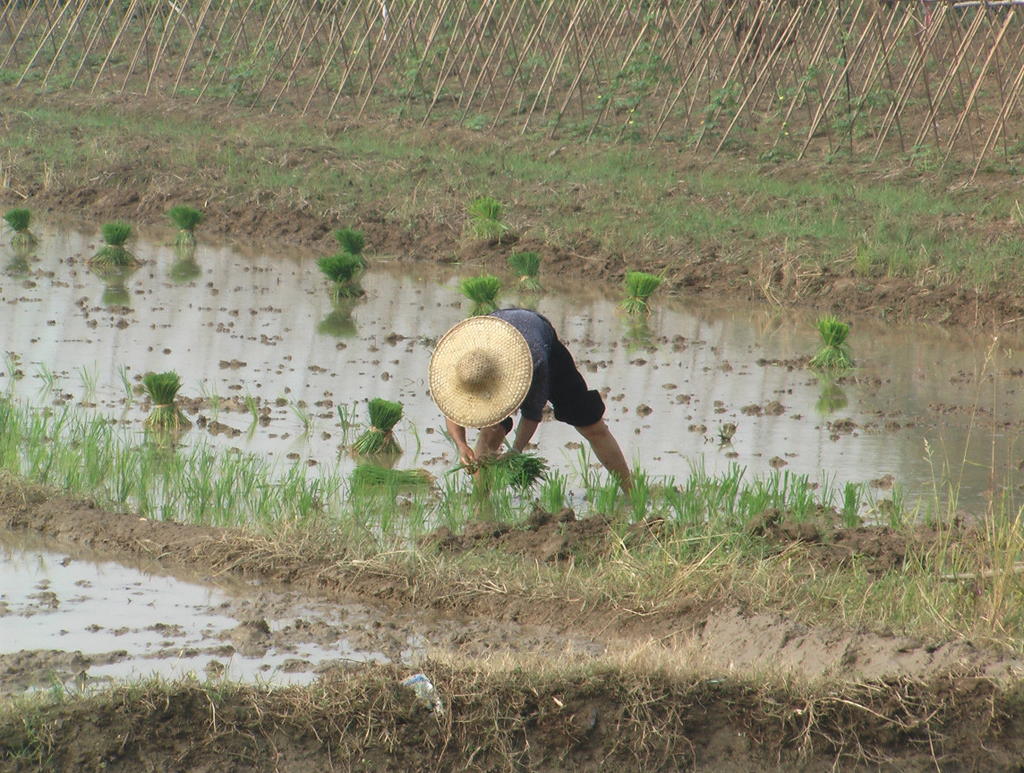
In the next field one might glimpse the bobbing straw hats of another farmer family. Here, still deep in flooded ground, the farmers stand, bent at the waist, their hands darting in and out of the mud, each jab leaving a tender, single strand of a rice seedling. Each farmer works a band three to four feet wide, as far as they are able to reach on either side. Up and down they work until their rice paddy is filled.

As I sat today and watched the harvest, I realized that no stage of rice production is easy. From the struggle against the soil in preparation, to the back breaking strain of planting, to the relentless sun of the harvest, it seems that nature fights the farmer at every turn. And the struggle is not yet over, for each farmer will take the harvested rice home to lay out in the hot sun to dry, a process that will require many turnings and sifts in order for the rice kernels to dry enough so that they wouldn’t spoil on the way to market.

It may seem obvious to others, but I need frequent reminding where my food comes from. At home, I run to the store and quickly grab my bag of rice or beans, my plastic-wrapped meat, my gallon of milk, and rush home without giving a second thought to the cost of the food. I don’t mean the price I pay at the register, but the cost in human terms of the food I take for granted daily.

China doesn’t allow that luxury. Meat is purchased by most Chinese families still on the hoof. Markets are crammed with baskets and cages of live chickens, ducks, and pigs which are purchased and slaughtered on the spot. Vegetables and fruits are grown by ones neighbors, the grains bagged at the local co-op down the street. The Chinese witness on a constant basis where their food comes from, a recognition I appreciate and long for in my own culture.

We have a policy in our house that plates should be emptied as much as possible at dinnertime, but under no circumstances should meat be left uneaten. I instill in my children an appreciation that a pig, cow, or chicken gave its life for their culinary enjoyment, and that to not eat their gift would mean that the animal died in vain. “No one should live and die in vain,” I tell my girls.

But as I watched the farmers today in the hot Guilin rice field, I realized that it is also unacceptable to let the hard labor of our food producers go to waste. For the value of a grain of rice is not measured by the pound at the cash register, but by the sweat that went into producing it. In China the two values are not the same.

Tuesday, August 23, 2005

China's Missing Daughters


The following experience occurred while my wife, daughter and I travelled from Jiangxi Province to Xi'An following a research project in May 2004.
________________

As we sat in the airport terminal waiting to board our plane to Xi'An, an older woman approached and asked me about my daughter Meigon. We had long ago grown used to the attention Meigon and I received, me for being a blond-haired Westerner, her for being a small three year-old Chinese girl rattling on incessantly in perfect English. This woman also had a young two year-old girl in tow.

I explained that my daughter was from Guangzhou, and that we had become a family in 2001. A few minutes pause, and the woman began to tell me her story.

She owned a shop in the airport, and her daughter was actually a "foundling". The grandmotherly woman had been walking home one evening and had chanced upon the six-day old baby along the side of the road. In an instant she decided to keep the baby herself, and quickly hid the baby under her clothes as she stole home.

This child remains a carefully guarded family secret. No one in her son's village (he is married with a child of his own) knows about the origins of the girl. She keeps a secret I believe is shared by hundreds of thousands of others throughout China.

My first experience with "foundlings" was when I returned to Meikina's orphanage a few years ago. In discussing the director's family with him, he revealed that his fourteen year-old daughter was actually a girl found by a close family friend. When this family migrated to New York when the girl was four, the family asked the director to be the her guardian, since she lacked the official paperwork required to migrate with the rest of the family. Ten years later he was still keeping watch over her.

As I have spoken with finders in the course of my research, almost without exception they have recounted how close they came to keeping the found girl themselves. One doctor-finder of twin girls had trouble convincing another witness not to take one of the girls home with her. It was only by appealing to this witness's sense of duty to let the twins grow up together that there were two girls found that day, and not one. I wonder how often that isn't the result.

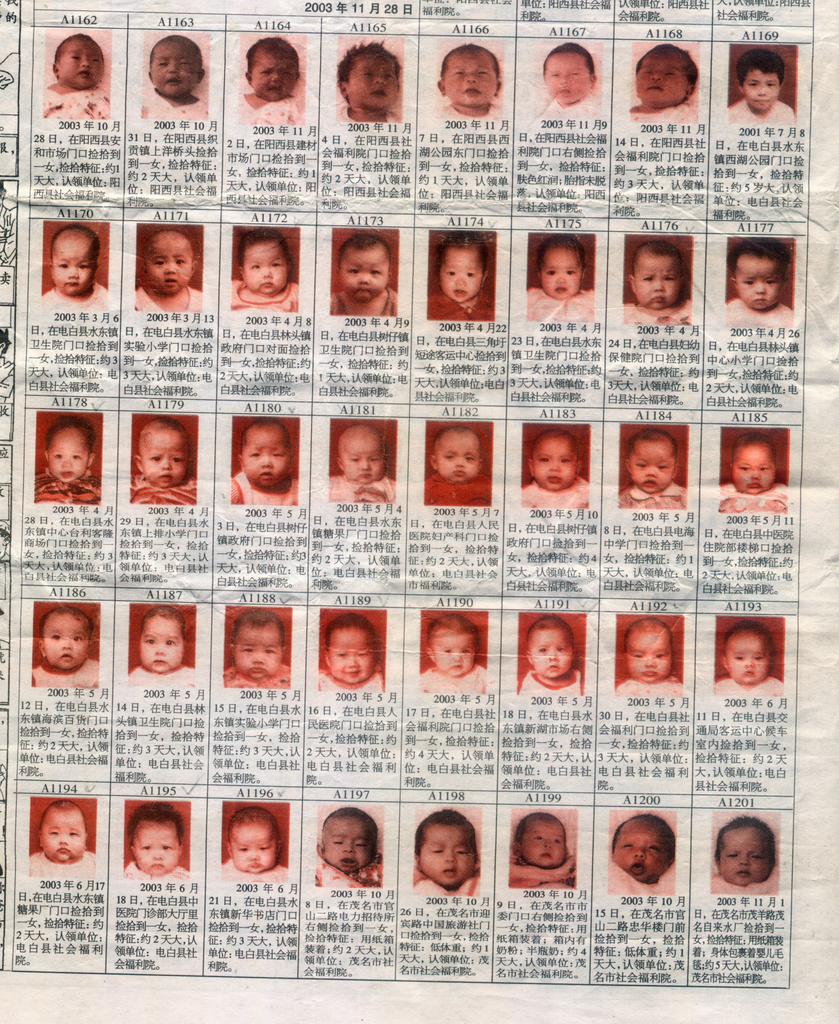
I estimate that there are around 250,000 children found every year which end up in China's orphanages (almost 40,000 in orphanages that do international adoptions). This figure is based on the number of finding ads placed in the Provincial newspapers each year, reporting the date and location for each foundling. How many are silently taken from the scene and raised in the village or town where they were found is unknown of course, but my instinct tells me it is also in the hundreds of thousands.

As adoptive families we are told that a search is launched each time a child is found, and the finding ads placed in newspapers are one facet of that search for a child's family. But the reality is that no search is made. I have stumbled upon witnesses that had substantial information regarding birth parents, and no inquiry was ever made of these people. It soon becames apparent that from the hospital staff to the police to the orphanage personel, all are accessories
after the fact, turning a blind eye to this problem, allowing birth parents to go uncaught and unpunished. Outwardly the Family Planning office seeks to prevent pregnancy and births through indoctrination and propaganda, but once the birth occurs, little is done, and most turn their heads and ask few questions.

I agree with this strategy.

The woman in the airport was able to afford what most can't -- the after birth registration fee to obtain an identification card for her daughter. When a woman becomes pregnant, she is encouraged to register her pending child with the local Family Planning office. For no fee, she can obtain an I.D. card for her future child, allowing her to have access to the area hospital and to later register her child in school, etc. But many do not register their child until after the child is born. Obtaining an I.D. card after the child is born is costly, costing the airport woman 8,000 rmb ($1,000), a small fortune for many Chinese.

Thus, many thousands of China's daughters remain unregistered members of China's society, forming an invisible and growing group hidden in the countryside and in the cities. These girls will have trouble gaining an education and jobs unless fees and fines are reduced and the I.D. process made possible. Until then, demographic numbers will continue to show an "imbalance" among China's children. China officially does nothing to rectify this perceived imbalance, because it allows them to encourage families to keep their girls by reporting that China faces a girl shortage.

Everyone wins, except China's hidden daughters.