A cursory view of nearly every adoption blog and newsgroup shows that the air is abuzz with speculation and rumors of what the future holds for China adoption. Although there is significant data and history on which accurate assessments can be based, it seems that nearly everyone is at a loss to explain why things are changing so dramatically.
As adoptive families, it is helpful to assess the current situation with tools learned in basic Economics 101. It is clear that China's international adoption program is experiencing a supply "crunch", which is to say that there are too few children available for immediate adoption to waiting foreign families. The immediate cause of this crunch was the Hunan stoppage that began in December 2005, and is just now ending. But a longer view shows that it has been building for years.
It is a misperception to think that this situation appeared overnight. In fact, a glance at the Yahoogroups dedicated to the various orphanages shows that each year orphanages have been added to the International Adoption program to bring in additional supply of children. This was done to compensate for the falling abandonment rates in the existing member orphanages. The goal is to keep the supply as constant and predictable as possible, and it has worked pretty well.
It is well-known that three Provinces provide a majority of the children adopted through the IA program -- Guangdong, Jiangxi and Hunan. When Hunan adoptions were paused in late December 2005, it took 20-25% of the adoptable children out of the supply pool. China's options were limited, especially since this was a very temporary problem. It was forced to let the "demand" back up, leading to longer and longer referral wait times. The DTC to referral wait times now stand at approximately 14 months.
With Hunan Province now coming back on line (we should see substantial Hunan referrals in the next month or so), the supply-demand equation should normalize. But China still faces a demand imbalance. Hunan doesn't totally explain the longer DTC referral wait times, just a portion of it. Thus, China is taking further actions to bring things into line.
It seems likely at this point that one step China will make in the near-term is the dramatic reduction, if not outright elimination, of the singles program. China has had ambivalent attitudes towards this program for years, and has taken periodic steps to reduce the number of singles that could adopt. This ambivalence stems from the cultural belief that children should be raised by two-parent families, coupled with the desire that China's children not be raised by homosexuals. Letters of Declarations (required by single applicants declaring their heterosexuality) aside, it is widely believed that gay parents continue to apply for adoption. Thus, it should come as no surprise to anyone that the first step to reducing the number of families permitted to adopt would be the elimination of the singles program (A compromise solution to outright elimination of these families would be the requirement that they apply for a waiting child).
Additional restrictions seem likely, perhaps health restrictions, income requirements, lowering upper-age limits for parents, and other means of reducing the number of families eligible to adopt. Additionally, new orphanages will probably be brought into the IA program. These changes are intended to bring the supply-demand equation back into balance.
But the referral wait time will not be brought back below 12 months, the stated goal of the CCAA, because simply put the longer wait times work to China's favor. As wait times increase, more families look to alternative options, and one option that will be presented in ever more favorable light is the waiting children program. Expedited referrals will be used to improve the attractiveness of this program, and many families will opt to adopt a Special Needs child, thereby reducing the demand for the healthy young children that are becoming increasingly more difficult for China to supply.
If viewed through the prism of simple supply-demand models, the events of the last 12 months become understandable. Often as waiting families we focus on each months referals, feverishly projecting the past to try and ascertain the future (one website has projected the wait time for a family submitting their paperwork today at 2 1/2 years!). By stepping back, we can see the larger picture, and see how the steps being taken by China will impact how adoptions are done. With most of China's orphanages now in modern, third-generation facilities, the "need" for monies derived from the IA program is diminishing. It still exists, and for that reason the IA program will continue. But we must realize that it is China's right, and perogative, to alter the program as they see fit to insure the life-long well-being of her children.
 To be notified of new postings, e-mail me.
We also have a paid subscription blog for families interested in more detailed analysis of China's program. Due to the sensitive nature of these articles, they are available by subscription only. (http://www.research-china.org/blogs/index.htm)
To be notified of new postings, e-mail me.
We also have a paid subscription blog for families interested in more detailed analysis of China's program. Due to the sensitive nature of these articles, they are available by subscription only. (http://www.research-china.org/blogs/index.htm)
Sunday, August 27, 2006


Saturday, August 05, 2006
The Long Road to My Baby
 China's population stands at 1.3 billion people. Often in our discussions about infant abandonment, domestic adoption, and other issues pertaining to International Adoption, we fail to see the trees for the forest. It is a big forest. Population estimates indicate that there are approximately 330 million couples in their reproductive years (20-50) in China. If these couples have the same infertility rate as couples in the West (10%), that equates to 33 million childless families.
The following story is a succinct yet heart-felt recounting of one Chinese woman's journey to motherhood. I met her on one of my research trips, and her story touched me deeply. It is a story that is at once familiar to many of us, yet also clearly illustrates the differences between our journeys and those in China.
It makes for profound reading.
_______________________________
One trying day towards the beginning of autumn 2002, due to a serious disease I was to have my uterus removed from my body. I never expected that I would have to face such a nightmare. My husband and I were just married and had yet to produce children. If my womb was taken from me, that meant that we would never be able to have children that were truly our own. This, in the eyes of a woman possessing Chinese traditional thinking and Chinese traditional desires, was a mortal blow. I have no way to convey the internal anguish caused by the loss that I had no choice but to face.
"Health is most important!" This is the sentence that my husband and family kept repeating to me. These words comforted me and encouraged me to do my best to actively cooperate with all of the doctor's work. Fortunately my illness was only in the initial stages, and so under the devoted care of my husband and family my body gradually recovered. At last, the continuation of my life was assured.
The days passed quickly, and my health continued to improve. We passed through the year happy and well. Nobody ever touched on the topic of children. My family worried that I was thinking too much of what I had lost and was quick to tell me once again that health is most important and to remind me to be sure to focus on my own recuperation. No matter what they would not abandon me. Nonetheless, the issue of children could only be briefly avoided. It had to be faced sooner or later! I began to ask myself repeatedly "What should I do? What should I do?"
Although I knew that my husband's father and mother were quite reasonable and extraordinarily kind hearted, more deeply I knew that they were a very traditional Chinese family. Moreover, my husband was their only male child. The old household of my husband was relatively backward and still gave a much loftier place to males. The ancestral feudalistic ways were thick and unwavering. In order to give birth to a son and "bring honor to the ancestors" many families would give all that they had. Families that failed to produce a son would be looked down upon and would not be able to hold their heads high. Our own family now had no hope of producing even our own little girl not to mention a treasured boy! Each time I thought on this matter while alone my eyes would be filled with tears, my inside filled with pain, and I would be left brimming with guilt towards my husband and family. At these times I would just repeatedly ask myself "What can I do? Adopt one? Ask another woman to have the child in my place? Divorce?”
I thought about it for a long time, but I could never make heads or tails of these perplexing questions. Truly, I had to admit that this disease and my inability to have children brought my husband and family immense pain and misfortune. This pain and misfortune certainly influenced the sentiment between us to a definite degree. As far as our future was concerned I did not want to think too much. That was too far away! My husband is a good person, and he was innocent. Nonetheless, divorce was the solution that I least wanted. Only if my husband were to bring it up himself would I respect his decision and accept divorce. To ask another woman to bear the child would also be quite a complex matter. I simply would not want to face the awkwardness and the bother in the future, and such an arrangement would no doubt cause me to sink back into anguish. Adoption eventually became the only natural choice. It was the choice that was best for my entire family, but what would they think? Would they accept it? At the beginning of 2004 our parents came to spend the Spring Festival with us. Mother brought up the topic of children. I was delighted to find out that they also supported adopting a child. For this decision I knew they had to throw away many of their traditional ways of looking at things, so I was moved to think that it had come out of concern for the future of my husband and I. Moreover, I was moved to feel gratified and at the same time to feel twice as much guilt and obligation towards them as before. They were so kind and reasonable! This kind of parents is really very hard to find.
My heart was really lifted then! Frankly speaking, to make that kind of decision, from the perspective of a very conservative mother and father, is really very hard and demands enormous courage. The only thing that I could do at the time was to silently resolve to warmly accept their approval. Oh my honorable parents! Just after telling me their opinion on the subject, mother said that due to the traditional way of thinking in our old home we would have to keep everything a secret from all of our neighbors and even our relatives. This all was to avoid the cold stares of those folk. Moreover, since my husband and I were constantly away from home working with few chances to return, it would be easy for those around our home to believe that the baby was indeed ours. We all therefore agreed with my mother's decision. I especially had no reason to disagree. I knew that this was a kind of necessary evil, and I deeply understood its importance. As far as my husband was concerned, he also approved of adopting a child, but he wanted to do so under a few conditions: He wanted a child from a completely normal healthy family. Specifically, he did not want a child born out of wedlock or one born without knowledge of his father. Secondly, he wanted to know some basic facts about the child's parents including about whether or not they had any hereditary diseases, their looks, and their moral character. Once satisfied he could agree to adopt. In fact, to a definite degree his way of thinking was in our best interest, and anyway I knew to adopt a child is somewhat unfair from the perspective of a husband. Who doesn't want to have their own child? I could only do my best to satisfy his small requests. Thus, we all agreed to adopt a child, and sooner rather than later.
In the male-biased old home of my husband, some women, in order to give birth to boy, first gave birth to more than a few girls. Owing to the fact that these households lack the ability to properly raise these children, most are sent to households that can better afford to do so. For this reason, we decided to look for opportunities to adopt children around my husband's old home. As soon as our parents returned home they began to make inquiries in all corners. In July of 2004, a close relative that works in a hospital called. She said that a woman there that had just given birth to her third girl was looking for a family in reasonable economic straits to which she could send her child to be raised. At the time as our mother was away visiting relatives, as my husband was wavering in hesitation, and because other potential adopters had already begun to make inquiries we soon had no choice but to let this opportunity go. After this I could not avoid feeling a little regretful and ended up spending the next few months in pain and anxiety. Somewhere around the Spring Festival of 2005, while talking with a friend I came to learn that she had adopted a lively and loveable little girl through an orphanage. Really pleasantly surprised, I decided to go to the orphanage myself. Perhaps I really would be able to get what I so desired from this unexpected opportunity. As I began to fill with hope I bustled about, inquiring about phone numbers and touching base with many welfare assistance centers. I made inquiries at the orphanage in the area that I was originally registered to live in, the one in which I now lived, the area where I work, and many other areas, totaling over ten orphanages. Nonetheless, contrary to my expectations, among them all I could not find any healthy baby girls to adopt. Outside of Guangxi province's Yulin city's center, all the centers used whatever reasons they could to turn me away. The thread of hope that had just been lit was extinguished in a moment. I was utterly disheartened.
Here I say that I was terribly disappointed that the orphanages told me that they had no children for me to adopt. Why? Why? Why? I wondered if these orphanages really had no babies for me to adopt, or if they did have babies but they never give me a chance. Why did they say no to a person who really wanted to adopt a child? They seemed to not care what I thought, and made me feel like salt was being poured into my wounds. I felt lost, and no longer knew what to do in order to find a child for my family.
China is a very traditional country, and most of the people are still very traditional and closed-minded. Nearly every couple hopes to have their own children, but 99% wish to have their own biological children. Some families, however, are not able to have biological children due to illness or other reasons. For these families life is very difficult, and since they can't have biological children, many get divorced and part ways. Adoption is the only way that many of these families feel they can stay together and remain as a family. For most infertile couples to be denied an adoption opportunity like I was would deal a fatal blow to many marriages.
Just as our entire family had once again sunken into helplessness, the relative from the hospital brought us some more news. She said that in the last couple of days a friend had come asking for her help. Her friend was to have a baby in just two months, and it seemed most likely that it would be her third girl. This friend wanted to give birth to a boy, so now she was looking for someone else that could raise this girl child. Speaking honestly, as far as our family was concerned, this really was exciting news! From our relative we came to learn more and more about the woman's family situation until we were completely satisfied. What's more the family of the child agreed never to see the child again. Even my husband willingly assented. After two long months of anxiety and anticipation, our long-awaited little girl finally arrived. Although we did in fact feel sorry for the little girl's family, we simply could not control our excitement. When the girl finally arrived the whole family was really very happy. We were really so happy then! Our little girl is an extremely lovely, beautiful, clever, little sweetheart. She is the best gift that heaven has given our family.
When I was arranging for our girl's hukou (household registration permit) mother put forward the idea of looking for someone to help us arrange for the hukous for a set of twins (one boy and one girl). She said that way if one did not work, for whatever reason, we could just get rid of it. I knew then that they were thinking that we might want to adopt another child, a boy. Honestly, why didn't I want to bring up another kid? That way would be healthier for the child's development then bringing him up alone, but we had to face reality. To bring up a single child is a great expense especially in a big city. We have to consider their education, medical treatment, and other costs. In our current economic state we really could not shoulder the burden of supporting two children. We could not afford to ensure that they both remained healthy or to give them any kind of truly beneficial childhood! It would be best just to raise one child and bring her up with all of our heart and soul. Such was the unanimous opinion of both I and my husband.
Speaking truthfully, I can understand why mother was thinking what she was. I can't blame her. Nonetheless, speaking from my innermost being I could only stand for raising one child. Yet, my heart was full of contradictions, really complicated feelings. Every scene from before was again flashing before my eyes. Mother and Father really exerted so much of themselves for me. During that brief period of time when I was in the hospital they took care of me in every possible way. After I got better, they still unceasingly encouraged and consoled me. They used all of the love that they had to forgive me for all the trouble that my disease had brought them. They were really an unfathomable pillar of support. I really should not once again be the cause of the sadness of these kindhearted parents! I thought then that perhaps I should stand in their position and think over the issue once again for their sake. So, being so moved, I have come to agree with mother's opinion. I hope that I can bring her a little comfort.
When our girl was half a year old we received a bit of news. There was a family that already had a grown boy, but now its mother had accidentally become pregnant once again. What's more the period in which abortion was allowed had already passed. If the baby born was a boy the family wanted to send it to someone that could take care of it. Father and mother were very happy to hear this bit of news, but because my husband was still entirely against adopting a baby boy they had no choice but to abandon this opportunity. Yet the matter is really not fully over and done with, we still don't have any way to know the final outcome. My husband's opinion on the subject is still the same as before. Now even I don't think about it too much. Everything that happens has its reason.
In short, no matter what, the thing that I most want to do is take very good care to raise my little girl well. I want to do my utmost to see that she can grow up healthy and strong.
Thursday, June 08, 2006
The Hague Agreement and China's International Adoption Program
This article was originally intended to be published in "Adoption Today" magazine. After submitting a rough draft of the article on May 1, 2006, Richard Fisher, the editor of "Adoption Today", and I worked through several rewrites to prepare it for publication in his magazine.
By late June 2006, after numerous suggestions and inputs from "Adoption Today", we discussed how to publish the article. Two alternatives were suggested. First, it was thought to have "Adoption Today" publish the article, with the publication on my blog occurring afterwards. Another alternative was to publish it to my blog first, referring readers to "Adoption Today", which was intending to include several side-bar articles to augment and expand on various aspects of the topic. Richard Fisher and I decided to publish the article first on my blog, and refer readers to "Adoption Today" for further information.
When I published this article on my blog, the response from many in the adoption community was anger and fear. The magazine was flooded with calls and e-mails from concerned families, most of them waiting for referrals. In a deciiosn that I can only assume was made out of fear of losing readers, "Adoption Today" changed its mind and decided not to publish the article. Additionally, Kim Hansel released an e-mail stating:
"Thank you for voicing your concerns. Brian Stuy has inaccurately stated that we will publish his article. As you expressed, there are several inaccuracies in Brian’s piece and as a publication that prides itself on accurate, honest reporting we will not publish what he has to say."
This statement was sent out, apparently without the approval of Richard Fisher, and is completely contrary to the editorial process that had occurred over the past two months.
The evidence presented in this article, obtained from a survey of EVERY orphanage involved in the international adoption process, paints a clear picture of the situation in China. The data presented was obtained from Chinese sources. If there are any "inaccuracies", I wait for someone to bring them to my attention.

The Hague Agreement and China's International Adoption Program
I got the first inkling that things were changing in China’s orphanages when I adopted Meigon in March 2002. As we visited the Guangzhou orphanage and walked the grounds with an officer at the orphanage, I asked her how many domestic adoptions the Guangzhou orphanage does each year. Hedging on the exact number, she replied that there was a three- to four-year waiting list of domestic families seeking to adopt. When I asked her how there could be a waiting list inside China while girls continued to be adopted internationally, she explained that the children adopted internationally had been passed over by domestic families in favor of more “attractive” children.
Experience and research since that time convinces me that the story is a bit more complicated than that. In January 2006, I published the results of my survey of 36 orphanages involved in the international adoption program (See my blog essay, "Domestic Adoption in China"). The results of that survey revealed that most of the orphanages surveyed (85%) claimed to have no healthy baby infants available for domestic adoption, even though adoptions of healthy children were performed for international families.
My conclusions that most of the orphanages involved in the international adoption program had implemented barriers that impeded domestic families from adopting were not universally accepted. Some criticized my sampling methods, feeling that 36 orphanages of nearly 250 total orphanages were not a large enough sample.1 “Your research seems inconclusive,” wrote one anonymous responder. “It is dangerous to make conclusions with incomplete data. I use the word dangerous because you are potentially impacting many lives.”
In order to gain additional insight into this issue, I began in April 2006 to conduct a systematic survey of all the orphanages involved in the international adoption program in China. I employed the same method used for the smaller survey: I had a Chinese national call each orphanage and ask for the director or someone else of position. She represented herself as a married woman, 35 years old, with no children. When asked where she lived, she would indicate that she lived in Guangzhou, but that her husband was local to the city where the orphanage was located. She would ask if there were any babies available for adoption, what the process was, and the fee to adopt. Wherever possible, she engaged the person into a general conversation about infant abandonment, and tried to gain empirical data from each orphanage. I employed this method in order to insure as much as possible that the answers I received were truthful, and intended no disrespect to these directors.
The results solidified the conclusions drawn from my earlier study, that many orphanages have established barriers for domestic families seeking to adopt. However, this complete survey of all the orphanages sheds additional light on the causes of recent trends in the China adoption program.
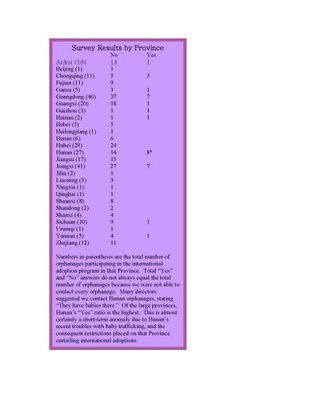
The first question my prospective adopter asked the orphanage was: “Are there any healthy children under two years of age available for adoption?” Of the 259 orphanages that answered this question(2), 227 answered this question negatively (88%). Of those that replied affirmatively, a few orphanages indicated that a “special relationship” with the director or Civil Affairs Office was required in order to adopt (Chongqing; Gansu), while several others indicated that an adoption could be arranged for a large adoption fee (in excess of 20,000 yuan) (Anhui, Chongqing, Guangxi, Hunan).3 Only 19 (7%) orphanages stated that my friend could adopt a healthy child immediately, with an adoption fee less than 20,000 yuan, although four of those indicated they had only one child available (Guangdong).
When asked why there were no healthy children available for adoption, nearly 36% (86) of the 227 directors that had stated they had no healthy children replied that abandonment of healthy infants has declined over the past several years and that mostly special needs children are now being found. The balance of the directors gave no explanation.
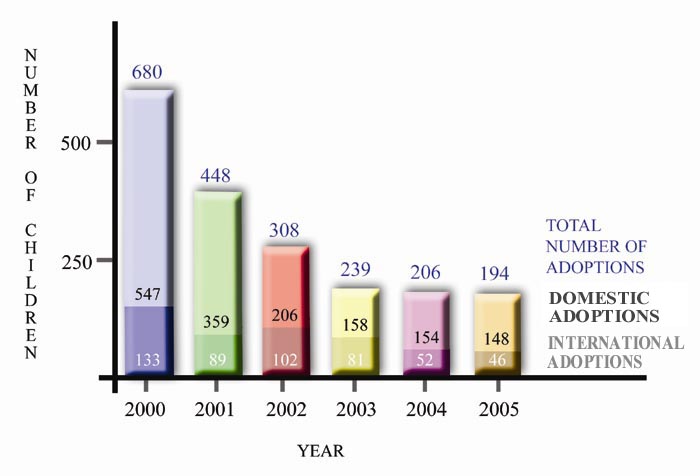
The decline in abandonment rates can be seen graphically by looking at the numbers from the Guangzhou orphanage. Children relinquished to the orphanage can end up in one of four categories: 1) domestically adopted; 2) internationally adopted; 3) remain in the orphanage until they reach 18 years old; or 4) die from illness or neglect. We can determine the first two categories with a high degree of precision by examining the finding ad publications for both groups. “Finding Ads” are legal notices published in various newspapers notifying birth parents that a child will be placed for adoption if unclaimed within 60 days. For domestic adoptions, these legal notices are published upon finalization of the adoption in the Guangzhou Daily, a widely read newspaper.4 For international adoptions, the ads are placed prior to the submission of a child’s paperwork to the China Center of Adoption Affairs (CCAA), the arm of the Chinese government responsible for state-sponsored adoptions.5

It can be clearly seen that the number of domestic adoptions has declined almost 75% over the last six years. The decline is also manifested in the number of international adoptions undertaken by the Guangzhou orphanage.
It seems likely that the declines in domestic and international adoptions are a result of fewer children being available for adoption. Many directors indicated that they felt that economic prosperity had reached their areas to the point that many more families were able to pay the fees assigned to second births,7 and thus no longer felt pressed by financial concerns to abandon their children. Several directors credited local Family Planning strictures with the decline (Hubei, Hunan, Zhejiang). Additionally, the Central Government’s announcement of the “Not One Less” program beginning in 2007 is stated to be having an impact on female abandonment by several directors in Jiangxi Province. This program, announced in March 2006, makes the nine years of compulsory education free for rural families. This saves the average farm-family more than 250 yuan per year (China Embassy, China Today).8 Other factors given by directors for the unavailability of healthy babies for domestic adoptions include fewer babies being found due to selective abortions occurring with the advent of ultrasound (Shaanxi). On the other side of the equation, several directors believed that attitudes in their areas had radically changed over the last few years, and that families were simply keeping their daughters (Jiangsu). Lastly, not a few directors simply replied that their orphanage only adopted children through the CCAA, and not to local families (Chongqing, Guangdong, Hubei, Jiangxi, Liaoning, Shaanxi).
Several orphanages indicated that once a child’s paperwork is forwarded to the CCAA for international adoption, it is almost impossible to retrieve the dossier in order to adopt that child domestically (Anhui; Guangdong). One director indicated that a child is ineligible for adoption until they are one month old, in order that the health and strength of that child can be determined (Guangdong). Many orphanages allow families to take possession of the child earlier, but push the finalization of the adoption (when it is registered) until much later, sometimes up to a year later. When a child reaches three or four months (Guangdong) her paperwork is forwarded to the CCAA for foreign adoption.
My own impressions from my travels and conversations in China is that most of China is seeing a decline in abandonment rates. The main reasons for this decline I believe are two-fold: the increased prosperity of families in China’s countryside, and the decline of “Chinese Traditionalism” which favors boys. Although I see little of China’s traditional bias to males among the young couples having the children in China, many confess to being pressured by grandparents, especially the paternal grandparents, to have boys. I believe that as the older generation dies off in China that abandonment rates will continue to fall (see my blog-essay “The Tale of Two Birthmothers” for more discussion on this point.
But the larger question still remains: Why do the orphanages continue to adopt internationally, while most have a long waiting list of domestic families ready and able to adopt those same children? I believe there are four components to this answer.
There is evidence to suggest that in a few cases children adopted internationally are those that were “passed over” by domestic families seeking to adopt, as the Guangzhou officer suggested. It is a common cultural tendency for Chinese couples to seek out children that will bring honor and respect to their family. Thus, children that display attractive physical features such as large round eyes, double eyelids, and round faces are considered desirable. One orphanage admitted that they had an “ugly” healthy baby girl available for adoption, having been passed over by many prospective families (Guangdong). Another director indicated that he prefers adopting to international families because domestic families pay too much attention to looks, and are thus too picky (Guangdong). Age of the child is also a consideration. Most domestic adoptions involve children less than six months of age. Children found when they are almost a year old or older face fewer prospects of being adopted domestically.
Another barrier to domestic adoption is the health of the child, and the perceived medical expenses that the adoptive family might incur to care for their child. Since most rural (and many urban) families lack health insurance, the potential for expensive medical treatments is a formidable concern for most adopting parents. When given the opportunity to adopt a child with a cleft pallet, for example, most Chinese families would be dissuaded by the expensive medical procedures needed to repair that deformity, and thus pass on adopting that child.
There can be little doubt that financial incentives motivate orphanages to place children for international adoption. I dealt with this particular issue at great length in my blog-article on the finances of baby trafficking. In summary, each internationally adopting family “donates” three thousand U.S. dollars to the orphanage at the time of adoption. In most cases this amount exceeds the donation made by domestic families. I am not asserting that an orphanage director benefits personally from increasing his orphanage’s cash flow by increasing international adoptions. Rather, given the realities of managing an orphanage, any conscientious director would likely do what he or she can to obtain as many financial resources as possible to improve the quality of care in his or her institution. This is especially true over the last few years, which have seen an increase in the percentage of special needs children being found. These children remain longer in the orphanages and require additional resources for medical expenses and care. The international adoption program is thus a price-floor mechanism for the orphanages: Given the demand for healthy infants by foreign families, and the large financial contributions they provide, any remaining children can be adopted to domestic families that also have good financial means. Thus, the revenue to the orphanage is maximized. One director, for example, confessed that although domestic adoption fees had been 6,000 to 8,000 yuan in the past, they had been raised to 15,000 yuan in order to provide additional funding to the special needs children flowing into the orphanage (Liaoning).
Another reason orphanage directors are biased to foreign adoption is the belief that children adopted internationally will have better futures and more opportunities than if they had been adopted domestically. Although it is difficult to say how much this plays into the decision of who is allowed to adopt, it certainly presents an obstacle to domestic adoption.
Lastly, many orphanages have restricted their domestic adoption program to families living in the orphanage’s area. When asked why families from other geographical areas of China are prohibited from adopting from their orphanage, most directors indicate that post-placement reporting is more difficult. Others indicate that given the disparity between supply and demand for healthy baby infants, it is felt that local families should be given first priority.
These factors, taken in aggregate, create significant barriers to families wishing to adopt children inside China. Some of these barriers, such as physical appearance and age of the child, are self-imposed obstacles, and could be overcome if the family would choose to do so. Others, such as the high financial requirements to adopt from most orphanages (ranging anywhere from 10,000 to 30,000 yuan) and future medical expenses lie largely outside the prospective adoptive family’s control. Altogether they combine to make it difficult, if not impossible, for most domestic families to find adoptable children. As one director put it, “many families call, but give up when they are told there are no healthy babies” (Henan).
The Hague Convention on the Protection of Children and Co-operation in Respect of Intercountry Adoption
In September 2005, China ratified the Hague Agreement on the Protection and Co-operation in Respect of Intercountry Adoption. One of the primary provisions of this agreement is the recognition “that intercountry adoption may offer the advantage of a permanent family to a child for whom a suitable family cannot be found in his or her State of origin.” Many of us adoptive parents question whether it would be better for China’s children to remain in their birth culture and country rather than being adopted into other lands, often becoming members of multi-racial families. Like many orphanage directors, we wonder which option presents the best opportunities for a child’s life and happiness – domestic or international adoption. But the world community as a body has determined that if possible, a child should remain in their country of origin before being adopted internationally. This understanding was codified in the Hague Agreement, and ratified by China. It appears from all the evidence presented above that China is in violation of that agreement by continuing to place healthy infant children with foreign families when many domestic families are desirous to adopt those same children.
As stated above, my survey of all the orphanages that participate in the international adoption program shows that 88% state that they have no healthy children available for domestic adoption. Below are the survey results for Guangxi Province. This province was chosen because every orphanage indicated to my interviewer that no healthy children were available. Next to each orphanage name is the number of dossiers that were submitted for international adoption in 2005:
Beihai -- 142
Cangwu -- 24
Cenxi -- 28
Desheng -- 70
Guigang -- 67
Guilin -- 113
Guiping -- 109
Hepu -- 64
Jingxi -- 13
Laibin -- 32
Liuzhou -- 55
Nanning -- 118
Pingnan -- 51
Qinzhou -- 39
Rongxian -- 8
Wuzhou -- 50
Yongning -- 18
Yulin -- 125
It is theoretically possible that all of these children were “passed over” by domestic families, or had medical issues which made them difficult to adopt to a Chinese family. However, a survey of 72 families that adopted children from these orphanages in 2005 and early 2006 revealed that only 17% of the children had special needs, with the balance (83%) being classified as “healthy”.9 The directors of the Cenxi, Guigang, Jingxi, Pingnan, and Yulin orphanages expressly stated that there were large numbers of domestic families waiting to adopt (30 to 40 in the case of Yulin), even as they continue to submit healthy children for international adoption.
Clearly, healthy children have and continue to be adopted internationally at the expense of families inside China that desire to build a family. It is possible that the difficulties experienced by domestic families seeking to adopt outlined above are found only in those orphanages that participate in the international adoption program. Thus, perhaps the rest of China’s orphanages that do not take part in international adoptions have abundant healthy children waiting for adoptive families in their facilities. One solution would be to increase participation in the international adoption program to all orphanages in China. This would spread the demand more evenly, and free up healthy children in the current internationally adopting orphanages to be adopted domestically. Given the number of children reportedly housed in these facilities, however, it seems likely that even this would not solve the demand imbalance.10
Another solution, and one which benefits all parties involved, would be to limit China’s international adoption program to those children who are, for one reason or another, “unadoptable” inside China. These would include children over 2 years or those with special needs, which are a growing and pressing problem in China’s orphanages.11 This would allow domestic families to adopt the healthy infants for which there is strong demand. Foreign families, most of whom have access to health care and other corrective medical technologies, would be able to adopt and give a home to a child who would otherwise most likely remain in an institution in China.12
In 2001 the Romanian and Cambodian international adoption programs were closed after it was shown that both countries had significant problems with their international adoption programs.13 In those cases, significant evidence of baby trafficking forced the closure of their programs until adequate safeguards could be implemented. These countries were violating basic human rights, and they deserved to be closed.
China is different. With the exception of the Hunan trafficking scandal reported in late 2005, its program has been the model of legitimacy.14 The issue is therefore much more complex, and focuses almost exclusively on the question of where the adopted child will have the best life and greatest opportunities. Setting aside the Hague agreement, as adoptive parents of Chinese children we must decide who should take priority in adopting these children. I frame the question thusly: I am the director of a Chinese orphanage and have a single healthy infant available for adoption. Two families apply to adopt the child, a middle-class Chinese family and a middle class American family. With whom would I place the child?
Personally, my instinctive reaction would be to place the child with a domestic family. As I wrote following the adoption of my oldest daughter Meikina, I have always felt that the loss of culture, language, country and religion to be important and significant in foreign adoption.15 I mourn the loss of these attributes of China in the lives of all three of my daughters. Tobias Hubinette, himself a Korean adoptee in Sweden, writes a biting criticism of the global international adoption program. “It is assumed that there are no special problems, emotional or psychological costs being a non-white adoptee in a white adoptive family and living in a predominantly white surrounding. Consequently, assimilation becomes the ideal as the adoptee is stripped of name, language, religion and culture, while the bonds to the biological family and the country of origin are cut off. Adoptees who are consciously dissociating themselves from their country of origin and see themselves as whites are interpreted as examples of successful adjustments, while interest in cultural heritage and biological roots is seen as an indication of poor mental health or condemned as expressions of biologism and Nationalism.” Hubinette goes on to quantify the problems of adjustment experienced by international adoptees, and the additional risk these individuals have in areas such as mental health, crime and suicide. He concludes, that given all of these problems, that “in this perspective, it becomes more evident than ever that intercountry adoption is nothing else but an irresponsible social experiment of gigantic measures, from the beginning to the end.”
Many adoptive families would disagree with some of Hubinette’s conclusions. Although Hubinette’s criticisms are directed largely at the Korean adoption program, parallels to the Chinese program are evident. The loss of culture and heritage has compelled many minority groups to come out in opposition to trans-racial adoption, including many Native American tribes. As adoptive parents of Chinese children, we often resist or ignore this problem by attending our FCC parties, teaching our children Mandarin, and participating in other activities designed to instill in our children a sense of “culture.” We must recognize that these are poor substitutes for authentic culture.
This loss, however, is simply the first layer of the onion. Comparing the positive attributes of Western culture to Eastern makes the judgment of what is in the best interest of the child more difficult. China’s perceptions of women, and its bias against women, offer a substantial counter-argument in favor of international adoption.16 Additionally, as many directors in my survey revealed, it is felt that educational opportunities are substantially better in the West. My children will be free to choose how long they will work, where they can live, which countries they visit, how many children they wish to raise, and a myriad other opportunities afforded citizens of the West that are absent from the lives of most women in China. How much these benefits offset the negatives of heritage loss is difficult to quantify and is a topic with which I constantly struggle.
With so many of the orphanages involved in China’s international adoption program reporting significant wait times for domestic families to adopt, it is clear that the number of healthy children available for adoption has fallen below the demand from both inside and outside China. International agreements state that given that circumstance, priority must be given to domestic families. Americans and families in other Western countries should consider this reality when making their decisions on where to adopt, and China must consider changing their program to address these realities. Together, solutions can be forged that benefit all of the children in China’s orphanages, especially those left behind.
_______________________________________
The following table shows the survey results by Province (click on image to make it more readable).
________________________________________
A word on how the orphanages were surveyed: Contact was made by phone, and my surveyor started by simply stating she was a married woman seeking to adopt a healthy child under 2 years of age. No mention was made as to where she lived, her age, income, etc. unless the director asked specifically for it. In over 90% of the calls, the director never asked. A small percentage simply hung up, which we quantified as a no-contact, although it seems likely they hung up because they were uninterested in adopting a child from their orphanage. In other words, I feel we would have received a "No" to our inquiry.
Most directors simply stated early in the conversation that there were no children available. Those that did inquire as to where my surveyor was from almost always indicated that there were children available. In other words, having my surveyor telling a small number of directors that she was from Guangzhou but that her husband was from the orphanage city had no detrimental impact on the results. I composed the script after considering all possible variables, and believe that this method insured the most "honest" answers.
An additional word to accusations about my "agenda": My agenda is simple -- the overall well-being of China's orphans. I certainly understand a difference of opinion as to what is better for a child -- adoption in-country or adoption to an international family. But minds vastly superior to mine have studied and concluded that it is in the best interest of the child to remain in-country whenever possible. We can debate that issue, but it forms the foundation of the Hague Agreement. Although I obviously am ambivalent about this difficult issue, in the international arena it has been decided, and by ratifying the Hague Agreement China has indicated agreement also.
Post Script: On August 12, Researcher/Author Kay Johnson posted the following comment to the blog. Due to problems with Blogger, I am including it here:
Brian, I just found this article on your blog (from a yahoo list) and find the information you provide very valuable. I agree that China adoption practices are not in accord with the principles formulated at the Hague and think your new evidence to this effect adds significant weight to this view. I made a similar argument in a 2002 article I published in Law and Society Review, on "The Politics of Domestic and International Adoption in China." My argument then rested heavily on the way adoption policy restricted domestic adoption at the same time the government opened up to international adoption. I argued that the restrictive adoption policy was a product of population control priorities, not child welfare needs. The policies themselves discriminate against foundlings (in contrast to orphans) and make it difficult for them to find new homes in China by drastically reducing the number of legal adopters in-country.
I also presented evidence from my research that some domestic adopters (those who already had a birth child) faced significant legal obstacles and harassment from birth planning authorities. At that time I had only anecdotal evidence that orphanage directors favored international adoption at the expense of domestic adoption due to the financial benefits (as opposed to merely guarding against the use of domestic adoption to hide overquota children). After the law was revised in 1999 to increase the legally approved pool of adopters, orphanages could have done much more to promote domestic adoption from the orphanage system. But many continued to apply the restrictive childless rule to Chinese adopters who came to the orphanage, while others imposed impossibly high fees on domestic adopters in an effort to discourage them.
Few directors I talked to were interested in seeking out domestic adopters let alone publicizing (though a few did); even people who lived in cities with large orphanages were often unaware of the availability of children for adoption or that the law had been revised to allow people with one child to adopt a second child from an orphanage. Meanwhile even the revised law continued to specify that those who adopted foundlings outside of orphanages (the vast majority of Chinese adopters) still had to be childless and over 30. This was, as before, to prevent people from using adoption to hide overquota children, even though this caused great hardship for many children and the adoptive parents who wanted to raise them. Your research has added a great deal to this picture. Although, as some of the blog comments indicate, it does not "prove" every orphanage prefers international over domestic adoption, it strongly suggests that many of those orphanages that participate in international adoptions do indeed discourage domestic adoption. The way orphanages are financed has weighted the system in this direction.
Your evidence is more than enough to illustrate this point and support your argument persuasively in my view. I believe, as you do, that there are more and more orphanages with a preponderance of disabled children today. These children need homes and cannot find them readily inside China due to the limited resources of most prospective adopters and the widespread lack of decent medical insurance in the countryside today. Increasingly, the children who truly cannot find homes in China need to be the ones served through international adoption. But this will require more changes in the system and the policies that govern it. I appreciate your efforts to promote those changes.
Kay Johnson
__________________________________________
Footnotes:
1. There is some disagreement as to how many orphanages exist in China. China’s Ministry of Civil Affairs reported in 2001 that there were 1,550 state-run orphanages, 160 of which specialized in the care of orphans. These facilities were said to have cared for approximately 41,000 children (Kay Johnson, “Wanting a Daughter, Needing a Son – Abandonment, Adoption and Orphanage Care in China”, Yeong & Yeong Book Company, p. 204). Jane Liedtke of “Our Chinese Daughters Foundation” (OCDF) puts the number of orphanages at over 750, with between 42,500 and 85,000 children institutionalized in those facilities. The number of orphanages continues to rise as China implements their redistricting program. This is resulting in more “district “ orphanages being created in the larger cities. Maoming City in Guangdong Province, for example, has, in addition to the city orphanage, two district orphanages – Maonan and Maogang. The Jiangcheng district orphanage in Yangjiang (Guangdong Province) is located 200 feet west of the Yangjiang City orphanage. A 2004 pronouncement states that “Today, China has 192 special welfare institutions for children and 600 comprehensive welfare institutions with a children's department, accommodating a total of 54,000 orphans and disabled children. My listing of the orphanages that participate in the international adoption program is drawn from the “Raising China Children” Yahoo Newsgroup. This site lists the orphanages for which individual newsgroups exist. These groups are formed by parents whose children were adopted from common cities as a way of gaining information about their child’s beginnings, and to remain in contact with their child’s “orphanage sisters” and "brothers." As of this writing (June 2006) there are 274 of these individual newsgroups, encompassing almost all of the internationally adopting orphanages in China. Additionally, I have added orphanages that publish finding ads for international adoption, even though no Yahoogroup exists. Thus, the total number of orphanages I attempted to survey was 292.
2. We were unable to interview 34 of the orphanages due to an inability to locate working phone numbers, or because the orphanage director simply “hung up” when we called.
3. In order to protect the identity of the orphanage directors, who were unaware that their conversations were to be used for publication, I am not able to identify how specific orphanages responded to individual questions, other than to refer to their province.
4. The term “Finding Ad” is a technical misnomer. The ads are not published to locate birth parents, but rather are legal notices transferring legal custody of the child from her birth family to the state, allowing for her adoption. In contrast to the finding ads placed for internationally adopted children, the finding ads published for domestically adopted children do not describe which orphanage the child was adopted from. In the case of the finding ads placed in the Guangzhou Daily, I relied on my wife’s knowledge of Guangzhou (she is native to Guangzhou) to determine which children most likely ended up in the Guangzhou orphanage. Since the finding ad describes what geographical area a child was found in, we were able to assign with high probability which orphanage they were taken to. Although I have taken great care to discern accurate numbers for Guangzhou’s domestically adopted finding ads, small mistakes were possibly made.
5. Category 3 consists mostly of unadoptable children, those possessing extreme mental and physical disabilities. Since there is little reason for an orphanage not to submit the paperwork for adoptable children, most unadopted children will fall into category 2, since their paperwork has been forwarded to the CCAA, but they have not been referred to a family for adoption. Both category 3 & 4 are difficult to determine, but is seems likely that over the past five years a small and declining number of children would fall into these categories.
6. It is possible that this number is inflated. Since the finding ads started in July 1999, it seems possible that 2000 ads might have been partially comprised of “catch-up” ads from the previous year. However, there was no “catching-up” with the international finding ads – if a child’s paperwork was already in process at the CCAA in July 1999, no finding ad was required to be published.
7. It is widely recognized that the problem of infant abandonment in China is primarily a result of the implementation of China’s “One Child Policy” in 1979. This policy, simply stated, allows urban families one child and rural families one child if that child is male. Rural families are allowed a second child if the first child is female. This policy recognizes a cultural bias to male children. Families that violate the policy by having additional children are subject to fines, job loss, and in some rare cases, forced sterilization procedures (http://geography.about.com/od/populationgeography/a/onechild.htm). Many scholars have written about China's rising wages, and it is these rising incomes that allow more parents to pay the fines associated with violating the Family Planning strictures against multiple children (http://yaleglobal.yale.edu/display.article?id=2242; http://www.unu.edu/unupress/unupbooks/uu10we/uu10we0l.htm).
8. Tuition has been free for Primary and Secondary students since 1986, but many rural families have been forced to pay “education expenses” for such things as text books, school heating, etc. The “Not One Less” program addresses these add-on expenses.
9. Families were located through the Guangxi Province newsgroups, as well as previous contact made to me for finding ads. We received health status from 72 of the roughly 1,288 children placed for adopt in 2005 from Guangxi. Sixty were classified as “Healthy”, while twelve had minor special needs.
10. In addition to contacting the orphanages that participate in the international adoption program, we also surveyed two orphanages that only adopt domestically. Both orphanages adopted only to local residents, and both had significant waiting lists of anxious families seeking to adopt.
11. Joshua Zhong, chairman of Chinese Children Adoption International (CCAI), believes that over 50% of the children in China’s orphanages are special needs. I view this estimate as very conservative, and believe it is much higher in actuality.
12. In many ways, this idea would reverse the adoption process that existed until 1999. Prior to that time international families were required to adopt a special needs child if they had other children at home or were younger than 35 years old (Karin Evans, “The Lost Daughters of China,” Jeremy P. Tarcher/Putnam, 2000, p. 175). Currently, a special needs child will only be referred to a family that specifically requests one.
13. Monica Youngs, “Overview of Country Shutdowns,” Adoption Today, February/March 2005, pp. 14-17. Romania closed due to pressure from the European Union, while Cambodia voluntarily closed their program rather than face censure from the international community.
14. The Hunan story was disturbing because it is the first known example of children being trafficked to orphanages in order to satisfy unfulfilled domestic and international demand for healthy children. The high adoption fee reported by a majority of orphanages contributes to China’s baby trafficking, I believe. A recent study by Chongqing University’s Zhang Weiguo in the March 2006 issue of Journal of Family Issues reveals that of the 425 domestic families surveyed that had adopted children “50 percent obtained their children through intermediaries (including so-called traffickers), 26 percent from family members, and 23 percent obtained children who were abandoned directly or found by friends, family, or neighbors. Less than one percent of the children covered in the study were adopted from state controlled orphanages.” Given the financial incentives to adopt internationally, most orphanages continue to charge high adoption fees to domestic families seeking to adopt children.
15. Brian H. Stuy, “A Train Ride to Maoming,” Adoption Today, July 2002, p. 46.
16. Evidence of China’s treatment of women, especially in the countryside, is the suicide rate among women -- the highest in the world. China is the only country where more women commit suicide than men (Karin Evans, p. 73).
By late June 2006, after numerous suggestions and inputs from "Adoption Today", we discussed how to publish the article. Two alternatives were suggested. First, it was thought to have "Adoption Today" publish the article, with the publication on my blog occurring afterwards. Another alternative was to publish it to my blog first, referring readers to "Adoption Today", which was intending to include several side-bar articles to augment and expand on various aspects of the topic. Richard Fisher and I decided to publish the article first on my blog, and refer readers to "Adoption Today" for further information.
When I published this article on my blog, the response from many in the adoption community was anger and fear. The magazine was flooded with calls and e-mails from concerned families, most of them waiting for referrals. In a deciiosn that I can only assume was made out of fear of losing readers, "Adoption Today" changed its mind and decided not to publish the article. Additionally, Kim Hansel released an e-mail stating:
"Thank you for voicing your concerns. Brian Stuy has inaccurately stated that we will publish his article. As you expressed, there are several inaccuracies in Brian’s piece and as a publication that prides itself on accurate, honest reporting we will not publish what he has to say."
This statement was sent out, apparently without the approval of Richard Fisher, and is completely contrary to the editorial process that had occurred over the past two months.
The evidence presented in this article, obtained from a survey of EVERY orphanage involved in the international adoption process, paints a clear picture of the situation in China. The data presented was obtained from Chinese sources. If there are any "inaccuracies", I wait for someone to bring them to my attention.
The Hague Agreement and China's International Adoption Program
I got the first inkling that things were changing in China’s orphanages when I adopted Meigon in March 2002. As we visited the Guangzhou orphanage and walked the grounds with an officer at the orphanage, I asked her how many domestic adoptions the Guangzhou orphanage does each year. Hedging on the exact number, she replied that there was a three- to four-year waiting list of domestic families seeking to adopt. When I asked her how there could be a waiting list inside China while girls continued to be adopted internationally, she explained that the children adopted internationally had been passed over by domestic families in favor of more “attractive” children.
Experience and research since that time convinces me that the story is a bit more complicated than that. In January 2006, I published the results of my survey of 36 orphanages involved in the international adoption program (See my blog essay, "Domestic Adoption in China"). The results of that survey revealed that most of the orphanages surveyed (85%) claimed to have no healthy baby infants available for domestic adoption, even though adoptions of healthy children were performed for international families.
My conclusions that most of the orphanages involved in the international adoption program had implemented barriers that impeded domestic families from adopting were not universally accepted. Some criticized my sampling methods, feeling that 36 orphanages of nearly 250 total orphanages were not a large enough sample.1 “Your research seems inconclusive,” wrote one anonymous responder. “It is dangerous to make conclusions with incomplete data. I use the word dangerous because you are potentially impacting many lives.”
In order to gain additional insight into this issue, I began in April 2006 to conduct a systematic survey of all the orphanages involved in the international adoption program in China. I employed the same method used for the smaller survey: I had a Chinese national call each orphanage and ask for the director or someone else of position. She represented herself as a married woman, 35 years old, with no children. When asked where she lived, she would indicate that she lived in Guangzhou, but that her husband was local to the city where the orphanage was located. She would ask if there were any babies available for adoption, what the process was, and the fee to adopt. Wherever possible, she engaged the person into a general conversation about infant abandonment, and tried to gain empirical data from each orphanage. I employed this method in order to insure as much as possible that the answers I received were truthful, and intended no disrespect to these directors.
The results solidified the conclusions drawn from my earlier study, that many orphanages have established barriers for domestic families seeking to adopt. However, this complete survey of all the orphanages sheds additional light on the causes of recent trends in the China adoption program.
The first question my prospective adopter asked the orphanage was: “Are there any healthy children under two years of age available for adoption?” Of the 259 orphanages that answered this question(2), 227 answered this question negatively (88%). Of those that replied affirmatively, a few orphanages indicated that a “special relationship” with the director or Civil Affairs Office was required in order to adopt (Chongqing; Gansu), while several others indicated that an adoption could be arranged for a large adoption fee (in excess of 20,000 yuan) (Anhui, Chongqing, Guangxi, Hunan).3 Only 19 (7%) orphanages stated that my friend could adopt a healthy child immediately, with an adoption fee less than 20,000 yuan, although four of those indicated they had only one child available (Guangdong).
When asked why there were no healthy children available for adoption, nearly 36% (86) of the 227 directors that had stated they had no healthy children replied that abandonment of healthy infants has declined over the past several years and that mostly special needs children are now being found. The balance of the directors gave no explanation.
The decline in abandonment rates can be seen graphically by looking at the numbers from the Guangzhou orphanage. Children relinquished to the orphanage can end up in one of four categories: 1) domestically adopted; 2) internationally adopted; 3) remain in the orphanage until they reach 18 years old; or 4) die from illness or neglect. We can determine the first two categories with a high degree of precision by examining the finding ad publications for both groups. “Finding Ads” are legal notices published in various newspapers notifying birth parents that a child will be placed for adoption if unclaimed within 60 days. For domestic adoptions, these legal notices are published upon finalization of the adoption in the Guangzhou Daily, a widely read newspaper.4 For international adoptions, the ads are placed prior to the submission of a child’s paperwork to the China Center of Adoption Affairs (CCAA), the arm of the Chinese government responsible for state-sponsored adoptions.5
It can be clearly seen that the number of domestic adoptions has declined almost 75% over the last six years. The decline is also manifested in the number of international adoptions undertaken by the Guangzhou orphanage.
It seems likely that the declines in domestic and international adoptions are a result of fewer children being available for adoption. Many directors indicated that they felt that economic prosperity had reached their areas to the point that many more families were able to pay the fees assigned to second births,7 and thus no longer felt pressed by financial concerns to abandon their children. Several directors credited local Family Planning strictures with the decline (Hubei, Hunan, Zhejiang). Additionally, the Central Government’s announcement of the “Not One Less” program beginning in 2007 is stated to be having an impact on female abandonment by several directors in Jiangxi Province. This program, announced in March 2006, makes the nine years of compulsory education free for rural families. This saves the average farm-family more than 250 yuan per year (China Embassy, China Today).8 Other factors given by directors for the unavailability of healthy babies for domestic adoptions include fewer babies being found due to selective abortions occurring with the advent of ultrasound (Shaanxi). On the other side of the equation, several directors believed that attitudes in their areas had radically changed over the last few years, and that families were simply keeping their daughters (Jiangsu). Lastly, not a few directors simply replied that their orphanage only adopted children through the CCAA, and not to local families (Chongqing, Guangdong, Hubei, Jiangxi, Liaoning, Shaanxi).
Several orphanages indicated that once a child’s paperwork is forwarded to the CCAA for international adoption, it is almost impossible to retrieve the dossier in order to adopt that child domestically (Anhui; Guangdong). One director indicated that a child is ineligible for adoption until they are one month old, in order that the health and strength of that child can be determined (Guangdong). Many orphanages allow families to take possession of the child earlier, but push the finalization of the adoption (when it is registered) until much later, sometimes up to a year later. When a child reaches three or four months (Guangdong) her paperwork is forwarded to the CCAA for foreign adoption.
My own impressions from my travels and conversations in China is that most of China is seeing a decline in abandonment rates. The main reasons for this decline I believe are two-fold: the increased prosperity of families in China’s countryside, and the decline of “Chinese Traditionalism” which favors boys. Although I see little of China’s traditional bias to males among the young couples having the children in China, many confess to being pressured by grandparents, especially the paternal grandparents, to have boys. I believe that as the older generation dies off in China that abandonment rates will continue to fall (see my blog-essay “The Tale of Two Birthmothers” for more discussion on this point.
But the larger question still remains: Why do the orphanages continue to adopt internationally, while most have a long waiting list of domestic families ready and able to adopt those same children? I believe there are four components to this answer.
There is evidence to suggest that in a few cases children adopted internationally are those that were “passed over” by domestic families seeking to adopt, as the Guangzhou officer suggested. It is a common cultural tendency for Chinese couples to seek out children that will bring honor and respect to their family. Thus, children that display attractive physical features such as large round eyes, double eyelids, and round faces are considered desirable. One orphanage admitted that they had an “ugly” healthy baby girl available for adoption, having been passed over by many prospective families (Guangdong). Another director indicated that he prefers adopting to international families because domestic families pay too much attention to looks, and are thus too picky (Guangdong). Age of the child is also a consideration. Most domestic adoptions involve children less than six months of age. Children found when they are almost a year old or older face fewer prospects of being adopted domestically.
Another barrier to domestic adoption is the health of the child, and the perceived medical expenses that the adoptive family might incur to care for their child. Since most rural (and many urban) families lack health insurance, the potential for expensive medical treatments is a formidable concern for most adopting parents. When given the opportunity to adopt a child with a cleft pallet, for example, most Chinese families would be dissuaded by the expensive medical procedures needed to repair that deformity, and thus pass on adopting that child.
There can be little doubt that financial incentives motivate orphanages to place children for international adoption. I dealt with this particular issue at great length in my blog-article on the finances of baby trafficking. In summary, each internationally adopting family “donates” three thousand U.S. dollars to the orphanage at the time of adoption. In most cases this amount exceeds the donation made by domestic families. I am not asserting that an orphanage director benefits personally from increasing his orphanage’s cash flow by increasing international adoptions. Rather, given the realities of managing an orphanage, any conscientious director would likely do what he or she can to obtain as many financial resources as possible to improve the quality of care in his or her institution. This is especially true over the last few years, which have seen an increase in the percentage of special needs children being found. These children remain longer in the orphanages and require additional resources for medical expenses and care. The international adoption program is thus a price-floor mechanism for the orphanages: Given the demand for healthy infants by foreign families, and the large financial contributions they provide, any remaining children can be adopted to domestic families that also have good financial means. Thus, the revenue to the orphanage is maximized. One director, for example, confessed that although domestic adoption fees had been 6,000 to 8,000 yuan in the past, they had been raised to 15,000 yuan in order to provide additional funding to the special needs children flowing into the orphanage (Liaoning).
Another reason orphanage directors are biased to foreign adoption is the belief that children adopted internationally will have better futures and more opportunities than if they had been adopted domestically. Although it is difficult to say how much this plays into the decision of who is allowed to adopt, it certainly presents an obstacle to domestic adoption.
Lastly, many orphanages have restricted their domestic adoption program to families living in the orphanage’s area. When asked why families from other geographical areas of China are prohibited from adopting from their orphanage, most directors indicate that post-placement reporting is more difficult. Others indicate that given the disparity between supply and demand for healthy baby infants, it is felt that local families should be given first priority.
These factors, taken in aggregate, create significant barriers to families wishing to adopt children inside China. Some of these barriers, such as physical appearance and age of the child, are self-imposed obstacles, and could be overcome if the family would choose to do so. Others, such as the high financial requirements to adopt from most orphanages (ranging anywhere from 10,000 to 30,000 yuan) and future medical expenses lie largely outside the prospective adoptive family’s control. Altogether they combine to make it difficult, if not impossible, for most domestic families to find adoptable children. As one director put it, “many families call, but give up when they are told there are no healthy babies” (Henan).
The Hague Convention on the Protection of Children and Co-operation in Respect of Intercountry Adoption
In September 2005, China ratified the Hague Agreement on the Protection and Co-operation in Respect of Intercountry Adoption. One of the primary provisions of this agreement is the recognition “that intercountry adoption may offer the advantage of a permanent family to a child for whom a suitable family cannot be found in his or her State of origin.” Many of us adoptive parents question whether it would be better for China’s children to remain in their birth culture and country rather than being adopted into other lands, often becoming members of multi-racial families. Like many orphanage directors, we wonder which option presents the best opportunities for a child’s life and happiness – domestic or international adoption. But the world community as a body has determined that if possible, a child should remain in their country of origin before being adopted internationally. This understanding was codified in the Hague Agreement, and ratified by China. It appears from all the evidence presented above that China is in violation of that agreement by continuing to place healthy infant children with foreign families when many domestic families are desirous to adopt those same children.
As stated above, my survey of all the orphanages that participate in the international adoption program shows that 88% state that they have no healthy children available for domestic adoption. Below are the survey results for Guangxi Province. This province was chosen because every orphanage indicated to my interviewer that no healthy children were available. Next to each orphanage name is the number of dossiers that were submitted for international adoption in 2005:
Beihai -- 142
Cangwu -- 24
Cenxi -- 28
Desheng -- 70
Guigang -- 67
Guilin -- 113
Guiping -- 109
Hepu -- 64
Jingxi -- 13
Laibin -- 32
Liuzhou -- 55
Nanning -- 118
Pingnan -- 51
Qinzhou -- 39
Rongxian -- 8
Wuzhou -- 50
Yongning -- 18
Yulin -- 125
It is theoretically possible that all of these children were “passed over” by domestic families, or had medical issues which made them difficult to adopt to a Chinese family. However, a survey of 72 families that adopted children from these orphanages in 2005 and early 2006 revealed that only 17% of the children had special needs, with the balance (83%) being classified as “healthy”.9 The directors of the Cenxi, Guigang, Jingxi, Pingnan, and Yulin orphanages expressly stated that there were large numbers of domestic families waiting to adopt (30 to 40 in the case of Yulin), even as they continue to submit healthy children for international adoption.
Clearly, healthy children have and continue to be adopted internationally at the expense of families inside China that desire to build a family. It is possible that the difficulties experienced by domestic families seeking to adopt outlined above are found only in those orphanages that participate in the international adoption program. Thus, perhaps the rest of China’s orphanages that do not take part in international adoptions have abundant healthy children waiting for adoptive families in their facilities. One solution would be to increase participation in the international adoption program to all orphanages in China. This would spread the demand more evenly, and free up healthy children in the current internationally adopting orphanages to be adopted domestically. Given the number of children reportedly housed in these facilities, however, it seems likely that even this would not solve the demand imbalance.10
Another solution, and one which benefits all parties involved, would be to limit China’s international adoption program to those children who are, for one reason or another, “unadoptable” inside China. These would include children over 2 years or those with special needs, which are a growing and pressing problem in China’s orphanages.11 This would allow domestic families to adopt the healthy infants for which there is strong demand. Foreign families, most of whom have access to health care and other corrective medical technologies, would be able to adopt and give a home to a child who would otherwise most likely remain in an institution in China.12
In 2001 the Romanian and Cambodian international adoption programs were closed after it was shown that both countries had significant problems with their international adoption programs.13 In those cases, significant evidence of baby trafficking forced the closure of their programs until adequate safeguards could be implemented. These countries were violating basic human rights, and they deserved to be closed.
China is different. With the exception of the Hunan trafficking scandal reported in late 2005, its program has been the model of legitimacy.14 The issue is therefore much more complex, and focuses almost exclusively on the question of where the adopted child will have the best life and greatest opportunities. Setting aside the Hague agreement, as adoptive parents of Chinese children we must decide who should take priority in adopting these children. I frame the question thusly: I am the director of a Chinese orphanage and have a single healthy infant available for adoption. Two families apply to adopt the child, a middle-class Chinese family and a middle class American family. With whom would I place the child?
Personally, my instinctive reaction would be to place the child with a domestic family. As I wrote following the adoption of my oldest daughter Meikina, I have always felt that the loss of culture, language, country and religion to be important and significant in foreign adoption.15 I mourn the loss of these attributes of China in the lives of all three of my daughters. Tobias Hubinette, himself a Korean adoptee in Sweden, writes a biting criticism of the global international adoption program. “It is assumed that there are no special problems, emotional or psychological costs being a non-white adoptee in a white adoptive family and living in a predominantly white surrounding. Consequently, assimilation becomes the ideal as the adoptee is stripped of name, language, religion and culture, while the bonds to the biological family and the country of origin are cut off. Adoptees who are consciously dissociating themselves from their country of origin and see themselves as whites are interpreted as examples of successful adjustments, while interest in cultural heritage and biological roots is seen as an indication of poor mental health or condemned as expressions of biologism and Nationalism.” Hubinette goes on to quantify the problems of adjustment experienced by international adoptees, and the additional risk these individuals have in areas such as mental health, crime and suicide. He concludes, that given all of these problems, that “in this perspective, it becomes more evident than ever that intercountry adoption is nothing else but an irresponsible social experiment of gigantic measures, from the beginning to the end.”
Many adoptive families would disagree with some of Hubinette’s conclusions. Although Hubinette’s criticisms are directed largely at the Korean adoption program, parallels to the Chinese program are evident. The loss of culture and heritage has compelled many minority groups to come out in opposition to trans-racial adoption, including many Native American tribes. As adoptive parents of Chinese children, we often resist or ignore this problem by attending our FCC parties, teaching our children Mandarin, and participating in other activities designed to instill in our children a sense of “culture.” We must recognize that these are poor substitutes for authentic culture.
This loss, however, is simply the first layer of the onion. Comparing the positive attributes of Western culture to Eastern makes the judgment of what is in the best interest of the child more difficult. China’s perceptions of women, and its bias against women, offer a substantial counter-argument in favor of international adoption.16 Additionally, as many directors in my survey revealed, it is felt that educational opportunities are substantially better in the West. My children will be free to choose how long they will work, where they can live, which countries they visit, how many children they wish to raise, and a myriad other opportunities afforded citizens of the West that are absent from the lives of most women in China. How much these benefits offset the negatives of heritage loss is difficult to quantify and is a topic with which I constantly struggle.
With so many of the orphanages involved in China’s international adoption program reporting significant wait times for domestic families to adopt, it is clear that the number of healthy children available for adoption has fallen below the demand from both inside and outside China. International agreements state that given that circumstance, priority must be given to domestic families. Americans and families in other Western countries should consider this reality when making their decisions on where to adopt, and China must consider changing their program to address these realities. Together, solutions can be forged that benefit all of the children in China’s orphanages, especially those left behind.
_______________________________________
The following table shows the survey results by Province (click on image to make it more readable).
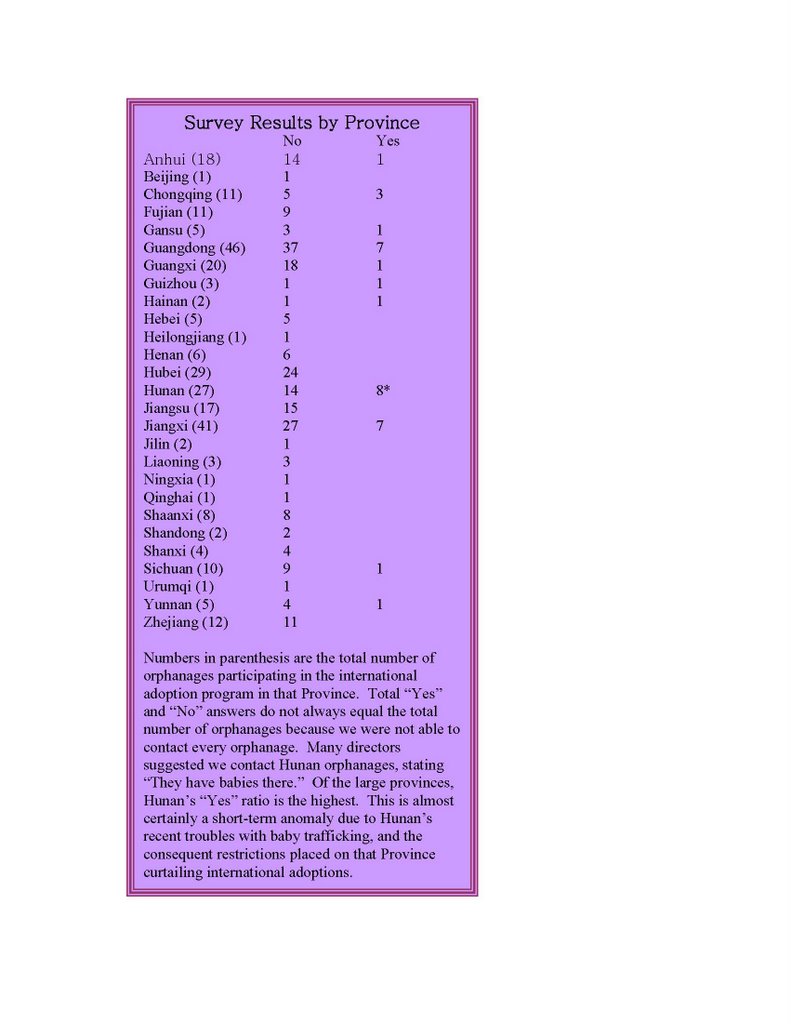
________________________________________
A word on how the orphanages were surveyed: Contact was made by phone, and my surveyor started by simply stating she was a married woman seeking to adopt a healthy child under 2 years of age. No mention was made as to where she lived, her age, income, etc. unless the director asked specifically for it. In over 90% of the calls, the director never asked. A small percentage simply hung up, which we quantified as a no-contact, although it seems likely they hung up because they were uninterested in adopting a child from their orphanage. In other words, I feel we would have received a "No" to our inquiry.
Most directors simply stated early in the conversation that there were no children available. Those that did inquire as to where my surveyor was from almost always indicated that there were children available. In other words, having my surveyor telling a small number of directors that she was from Guangzhou but that her husband was from the orphanage city had no detrimental impact on the results. I composed the script after considering all possible variables, and believe that this method insured the most "honest" answers.
An additional word to accusations about my "agenda": My agenda is simple -- the overall well-being of China's orphans. I certainly understand a difference of opinion as to what is better for a child -- adoption in-country or adoption to an international family. But minds vastly superior to mine have studied and concluded that it is in the best interest of the child to remain in-country whenever possible. We can debate that issue, but it forms the foundation of the Hague Agreement. Although I obviously am ambivalent about this difficult issue, in the international arena it has been decided, and by ratifying the Hague Agreement China has indicated agreement also.
Post Script: On August 12, Researcher/Author Kay Johnson posted the following comment to the blog. Due to problems with Blogger, I am including it here:
Brian, I just found this article on your blog (from a yahoo list) and find the information you provide very valuable. I agree that China adoption practices are not in accord with the principles formulated at the Hague and think your new evidence to this effect adds significant weight to this view. I made a similar argument in a 2002 article I published in Law and Society Review, on "The Politics of Domestic and International Adoption in China." My argument then rested heavily on the way adoption policy restricted domestic adoption at the same time the government opened up to international adoption. I argued that the restrictive adoption policy was a product of population control priorities, not child welfare needs. The policies themselves discriminate against foundlings (in contrast to orphans) and make it difficult for them to find new homes in China by drastically reducing the number of legal adopters in-country.
I also presented evidence from my research that some domestic adopters (those who already had a birth child) faced significant legal obstacles and harassment from birth planning authorities. At that time I had only anecdotal evidence that orphanage directors favored international adoption at the expense of domestic adoption due to the financial benefits (as opposed to merely guarding against the use of domestic adoption to hide overquota children). After the law was revised in 1999 to increase the legally approved pool of adopters, orphanages could have done much more to promote domestic adoption from the orphanage system. But many continued to apply the restrictive childless rule to Chinese adopters who came to the orphanage, while others imposed impossibly high fees on domestic adopters in an effort to discourage them.
Few directors I talked to were interested in seeking out domestic adopters let alone publicizing (though a few did); even people who lived in cities with large orphanages were often unaware of the availability of children for adoption or that the law had been revised to allow people with one child to adopt a second child from an orphanage. Meanwhile even the revised law continued to specify that those who adopted foundlings outside of orphanages (the vast majority of Chinese adopters) still had to be childless and over 30. This was, as before, to prevent people from using adoption to hide overquota children, even though this caused great hardship for many children and the adoptive parents who wanted to raise them. Your research has added a great deal to this picture. Although, as some of the blog comments indicate, it does not "prove" every orphanage prefers international over domestic adoption, it strongly suggests that many of those orphanages that participate in international adoptions do indeed discourage domestic adoption. The way orphanages are financed has weighted the system in this direction.
Your evidence is more than enough to illustrate this point and support your argument persuasively in my view. I believe, as you do, that there are more and more orphanages with a preponderance of disabled children today. These children need homes and cannot find them readily inside China due to the limited resources of most prospective adopters and the widespread lack of decent medical insurance in the countryside today. Increasingly, the children who truly cannot find homes in China need to be the ones served through international adoption. But this will require more changes in the system and the policies that govern it. I appreciate your efforts to promote those changes.
Kay Johnson
__________________________________________
Footnotes:
1. There is some disagreement as to how many orphanages exist in China. China’s Ministry of Civil Affairs reported in 2001 that there were 1,550 state-run orphanages, 160 of which specialized in the care of orphans. These facilities were said to have cared for approximately 41,000 children (Kay Johnson, “Wanting a Daughter, Needing a Son – Abandonment, Adoption and Orphanage Care in China”, Yeong & Yeong Book Company, p. 204). Jane Liedtke of “Our Chinese Daughters Foundation” (OCDF) puts the number of orphanages at over 750, with between 42,500 and 85,000 children institutionalized in those facilities. The number of orphanages continues to rise as China implements their redistricting program. This is resulting in more “district “ orphanages being created in the larger cities. Maoming City in Guangdong Province, for example, has, in addition to the city orphanage, two district orphanages – Maonan and Maogang. The Jiangcheng district orphanage in Yangjiang (Guangdong Province) is located 200 feet west of the Yangjiang City orphanage. A 2004 pronouncement states that “Today, China has 192 special welfare institutions for children and 600 comprehensive welfare institutions with a children's department, accommodating a total of 54,000 orphans and disabled children. My listing of the orphanages that participate in the international adoption program is drawn from the “Raising China Children” Yahoo Newsgroup. This site lists the orphanages for which individual newsgroups exist. These groups are formed by parents whose children were adopted from common cities as a way of gaining information about their child’s beginnings, and to remain in contact with their child’s “orphanage sisters” and "brothers." As of this writing (June 2006) there are 274 of these individual newsgroups, encompassing almost all of the internationally adopting orphanages in China. Additionally, I have added orphanages that publish finding ads for international adoption, even though no Yahoogroup exists. Thus, the total number of orphanages I attempted to survey was 292.
2. We were unable to interview 34 of the orphanages due to an inability to locate working phone numbers, or because the orphanage director simply “hung up” when we called.
3. In order to protect the identity of the orphanage directors, who were unaware that their conversations were to be used for publication, I am not able to identify how specific orphanages responded to individual questions, other than to refer to their province.
4. The term “Finding Ad” is a technical misnomer. The ads are not published to locate birth parents, but rather are legal notices transferring legal custody of the child from her birth family to the state, allowing for her adoption. In contrast to the finding ads placed for internationally adopted children, the finding ads published for domestically adopted children do not describe which orphanage the child was adopted from. In the case of the finding ads placed in the Guangzhou Daily, I relied on my wife’s knowledge of Guangzhou (she is native to Guangzhou) to determine which children most likely ended up in the Guangzhou orphanage. Since the finding ad describes what geographical area a child was found in, we were able to assign with high probability which orphanage they were taken to. Although I have taken great care to discern accurate numbers for Guangzhou’s domestically adopted finding ads, small mistakes were possibly made.
5. Category 3 consists mostly of unadoptable children, those possessing extreme mental and physical disabilities. Since there is little reason for an orphanage not to submit the paperwork for adoptable children, most unadopted children will fall into category 2, since their paperwork has been forwarded to the CCAA, but they have not been referred to a family for adoption. Both category 3 & 4 are difficult to determine, but is seems likely that over the past five years a small and declining number of children would fall into these categories.
6. It is possible that this number is inflated. Since the finding ads started in July 1999, it seems possible that 2000 ads might have been partially comprised of “catch-up” ads from the previous year. However, there was no “catching-up” with the international finding ads – if a child’s paperwork was already in process at the CCAA in July 1999, no finding ad was required to be published.
7. It is widely recognized that the problem of infant abandonment in China is primarily a result of the implementation of China’s “One Child Policy” in 1979. This policy, simply stated, allows urban families one child and rural families one child if that child is male. Rural families are allowed a second child if the first child is female. This policy recognizes a cultural bias to male children. Families that violate the policy by having additional children are subject to fines, job loss, and in some rare cases, forced sterilization procedures (http://geography.about.com/od/populationgeography/a/onechild.htm). Many scholars have written about China's rising wages, and it is these rising incomes that allow more parents to pay the fines associated with violating the Family Planning strictures against multiple children (http://yaleglobal.yale.edu/display.article?id=2242; http://www.unu.edu/unupress/unupbooks/uu10we/uu10we0l.htm).
8. Tuition has been free for Primary and Secondary students since 1986, but many rural families have been forced to pay “education expenses” for such things as text books, school heating, etc. The “Not One Less” program addresses these add-on expenses.
9. Families were located through the Guangxi Province newsgroups, as well as previous contact made to me for finding ads. We received health status from 72 of the roughly 1,288 children placed for adopt in 2005 from Guangxi. Sixty were classified as “Healthy”, while twelve had minor special needs.
10. In addition to contacting the orphanages that participate in the international adoption program, we also surveyed two orphanages that only adopt domestically. Both orphanages adopted only to local residents, and both had significant waiting lists of anxious families seeking to adopt.
11. Joshua Zhong, chairman of Chinese Children Adoption International (CCAI), believes that over 50% of the children in China’s orphanages are special needs. I view this estimate as very conservative, and believe it is much higher in actuality.
12. In many ways, this idea would reverse the adoption process that existed until 1999. Prior to that time international families were required to adopt a special needs child if they had other children at home or were younger than 35 years old (Karin Evans, “The Lost Daughters of China,” Jeremy P. Tarcher/Putnam, 2000, p. 175). Currently, a special needs child will only be referred to a family that specifically requests one.
13. Monica Youngs, “Overview of Country Shutdowns,” Adoption Today, February/March 2005, pp. 14-17. Romania closed due to pressure from the European Union, while Cambodia voluntarily closed their program rather than face censure from the international community.
14. The Hunan story was disturbing because it is the first known example of children being trafficked to orphanages in order to satisfy unfulfilled domestic and international demand for healthy children. The high adoption fee reported by a majority of orphanages contributes to China’s baby trafficking, I believe. A recent study by Chongqing University’s Zhang Weiguo in the March 2006 issue of Journal of Family Issues reveals that of the 425 domestic families surveyed that had adopted children “50 percent obtained their children through intermediaries (including so-called traffickers), 26 percent from family members, and 23 percent obtained children who were abandoned directly or found by friends, family, or neighbors. Less than one percent of the children covered in the study were adopted from state controlled orphanages.” Given the financial incentives to adopt internationally, most orphanages continue to charge high adoption fees to domestic families seeking to adopt children.
15. Brian H. Stuy, “A Train Ride to Maoming,” Adoption Today, July 2002, p. 46.
16. Evidence of China’s treatment of women, especially in the countryside, is the suicide rate among women -- the highest in the world. China is the only country where more women commit suicide than men (Karin Evans, p. 73).
Tuesday, May 30, 2006
Why the Wait?
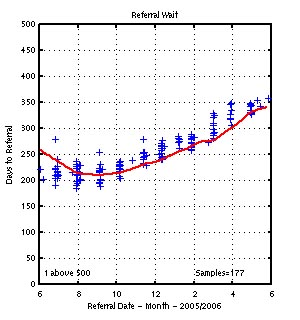
Having watched the time from DTC (Dossier-to-China) to referral ebb and flow over the eight years since my first adoption, I have not paid too much attention to waiting families' questions regarding when they will get "the call." But lately, I have been getting quite a few e-mails from families asking my opinion as to why the wait times are increasing. What follows is my opinion as to why wait times have been increasing since last fall.
First, it is important to keep the recent fluctuations in wait times in perspective. Thanks to the tireless efforts of Ralph Stirling, we can all see how long families have had to wait in the past.1 What is interesting to note is that the last time families had to wait this long for their referrals was late 2002, when referral wait times were coming down from a peak wait time of over 14 months reached earlier that year. The referral "moving average" hasn't reached that peak yet, so I guess the good news is that things have been worse.

But there are some very important forces at work this time that spell longer wait times, at least in the near term. A lot was made about the controversy over whether Hunan was closed to adoptions following the baby-trafficking story in November 2005. It is interesting to note that the finding ads in Hunan, the first step made by the Civil Affairs offices in each city to place a child in the international adoption pool, stopped completely in December 2005. The CCAA announced the completion of its investigation into the Hunan episode in March 2006, and finding ads again appeared in mid-April.
Hunan, along with Jiangxi and Guangdong Provinces, contributes a majority of the children adopted internationally. It seems likely that although a small number of Hunan referrals have been received in the past few months (all of which had finding ads published prior to December 2005, and thus "in-process" when the story broke) that we will not see significant numbers of Hunan referrals over the Summer. Given the number of children usually assigned from Hunan, this can be a significant factor in the lengthening wait times.
The CCAA has answered questions concerning the increasing wait times with an explanation of the declining number of children being abandoned in China. This is also certainly true, and also will have an effect on the wait times. In fact, as my next blog essay on the availability of adoptable children in China will show, over the long term the decline in abandonments will have a much more significant impact on China's international adoption program than the increasing wait times we have most recently been experiencing.
_____________________________
1. All graphs created by Ralph Stirling, and are used with his permission.
Subscribe to:
Comments (Atom)